

Descriptions
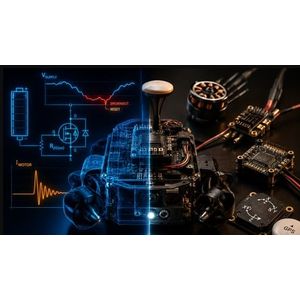
Electronics for Robotics 2026: Motor Drivers, ESCs & Sensors, Learn the electronics that power modern robots, drones, rovers, and autonomous systems. This course goes beyond software and control algorithms to explain what happens at the electrical layer, from batteries and power delivery to motor drivers, ESCs, flight controllers, communication buses, and sensors. Using free open-source ngspice simulations instead of physical hardware, you will explore voltage sag, current spikes, thermal behavior, signal integrity, noise, and sensor performance through realistic engineering scenarios. By understanding the electrical principles behind robotic systems, you will gain the ability to diagnose failures, select appropriate components, and design reliable robotic platforms with confidence.
What you’ll learn
- Read motor driver and ESC datasheets correctly and select components based on electrical and thermal requirements.
- Understand how H-bridges, MOSFETs, PWM control, and brushless ESCs operate in robotic systems.
- Diagnose electrical failures such as brownouts, supply sag, thermal issues, sensor interference, and intermittent connections.
- Design complete robot power and signal architectures including batteries, motor drivers, ESCs, flight controllers, and sensors.
- Analyze grounding, EMI, electrical noise, and signal integrity issues that affect robot performance.
- Work with common robotics communication buses including UART, I2C, SPI, CAN, Ethernet, and EtherCAT.
- Understand analog signal processing, ADC behavior, filtering techniques, and sensor data acquisition.
- Evaluate and integrate inertial, ranging, navigation, and perception sensors used in robotics applications.
Who this course is for
- Robotics engineers who want a deeper understanding of the electronics beneath control algorithms and software.
- Computer science graduates and developers working with robotics who need practical electronics knowledge.
- Drone, rover, autonomous vehicle, and underwater robot builders seeking to troubleshoot hardware-related issues.
- Students and makers who want to learn professional robotics electronics without purchasing expensive laboratory equipment.
- Engineers interested in motor control, sensors, power systems, embedded hardware, and robotic platform design.
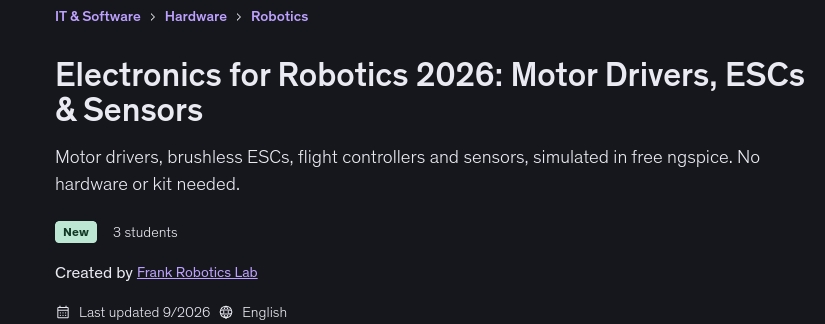
Specificatoin of Electronics for Robotics 2026: Motor Drivers, ESCs & Sensors
- Publisher : Udemy
- Teacher : Frank Robotics Lab
- Language : English
- Level : All Levels
- Number of Course :
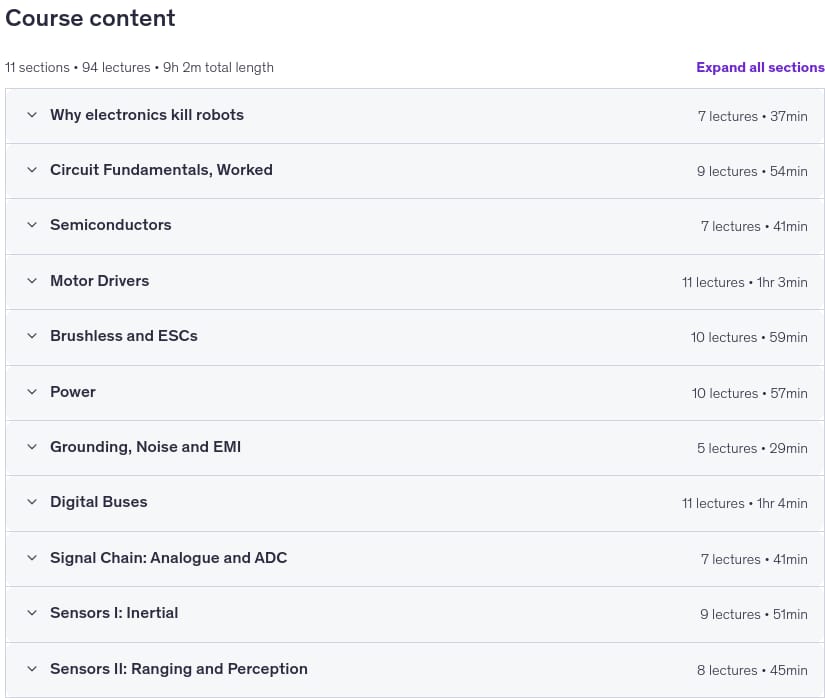
- Duration : 9 hours and 2 minutes
Content of Electronics for Robotics 2026: Motor Drivers, ESCs & Sensors
Requirements
- No hardware, kit or soldering required. No prior electronics needed beyond basic algebra. All simulations use free open-source ngspice, and every netlist is included.
Pictures
Sample Clip
Installation Guide
Extract the files and watch with your favorite player
Subtitle : English
Quality: 1080p
Download Links
Password file(s): www.downloadly.ir
File size
10.1 GB