


Descriptions
Build a Computer From Scratch: Binary to CPU to Assembly, Build a Computer from Logic Gates — From Binary to a Working 8-Bit CPU. Learn how computers work from the ground up by building your own 8-bit CPU using digital logic gates. This hands-on computer architecture and digital electronics course takes you from binary numbers, logic gates, and Boolean logic to building an ALU, RAM, ROM, control unit, instruction set architecture (ISA), and a fully functional 8-bit CPU. If you want to understand how a CPU actually works, how machine code becomes hardware operations, and how memory, registers, ALU, control logic, and buses work together, this course gives you a complete step-by-step journey from logic gates to a working computer. You don’t need advanced knowledge of computer architecture or digital electronics. Start with the fundamentals and progressively build every major component one logic gate at a time. You’ll understand the complete journey from binary numbers and logic gates to a working CPU. You’ll see how digital logic becomes an ALU, how sequential logic creates memory, how instructions are decoded, how machine code controls hardware, and how all these components work together inside a computer. Start with binary. Build logic gates. Create memory. Design an ALU. Build an 8-bit CPU. Write machine code. Program real hardware. Learn computer architecture by building a computer yourself — from logic gates to CPU.
What you’ll learn
- Convert between decimal and binary, and understand two’s complement negative numbers
- Perform binary addition and subtraction by hand
- Build logic gates into functional circuits (selectors, adders)
- Design a half-adder and full-adder, then chain them into a multi-bit ALU
- Add subtraction capability to an ALU circuit
- Understand sequential logic: latches and flip-flops for data storage
- Build Random Access Memory (RAM) and Read-Only Memory (ROM) from logic gates
- Connect ALU, RAM, and a bus architecture together
- Design an Instruction Set Architecture (ISA) and a control unit
- Implement conditional branching and a flags register
- Write and execute real machine-code programs, including Fibonacci
- Understand real-world CPUs: ARMv6, hexadecimal, and memory-mapped I/O
- Program an actual microcontroller using the concepts learned
Who this course is for
- CS/ECE students wanting to understand computer architecture fundamentals
- Self-taught programmers who want to know ‘what’s really happening’ under the hood
- VLSI/embedded/digital-design learners building foundational knowledge
- Anyone preparing for computer architecture interview questions
Specificatoin of Build a Computer From Scratch: Binary to CPU to Assembly
- Publisher : Udemy
- Teacher : MasterMind Academy
- Language : English
- Level : Beginner
- Number of Course : 53
- Duration : 11 hours and 13 minutes
Content of Build a Computer From Scratch: Binary to CPU to Assembly
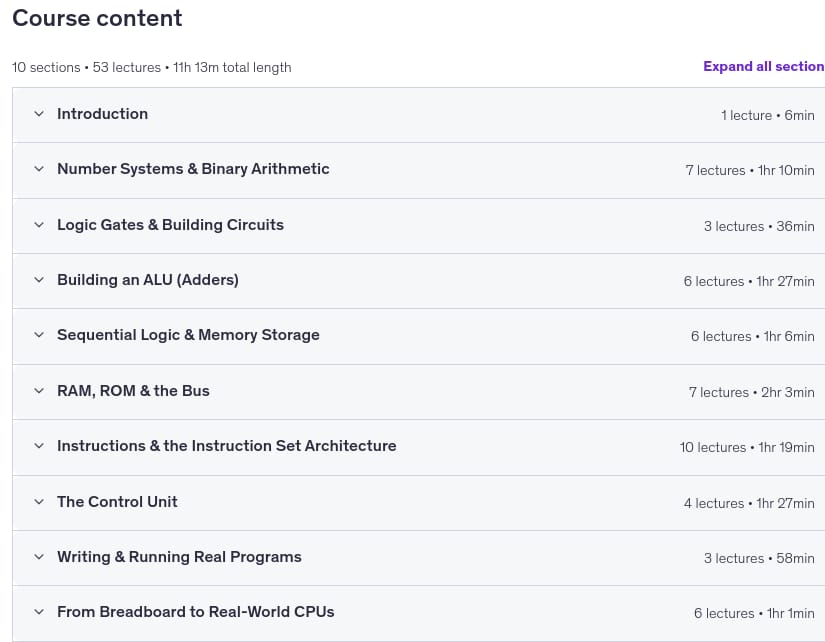
Requirements
- No prior electronics or programming experience required
- Curiosity about how computers work at the hardware level
- A basic microcontroller/dev board if following the final hands-on section
Pictures

Sample Clip
Installation Guide
Extract the files and watch with your favorite player
Subtitle : Not Available
Quality: 1080p
Download Links
Password file(s): www.downloadly.ir
File size
5.41 GB