

Descriptions
Hands-on Data Centric Visual AI, This comprehensive course is a hands-on guide to developing and maintaining high-quality datasets for visual AI applications. You will learn and apply various data-labeling approaches, from manual to fully automated methods; assess and improve annotation quality for object detection by identifying and correcting common labeling issues; analyze how bounding box quality affects model performance and develop strategies to improve label consistency; and use advanced tools such as FiftyOne and CVAT for dataset exploration, error correction, and annotation refinement. The course also addresses complex computer vision challenges, including overlapping detections, occlusions, and small object detection, while covering data augmentation techniques for improving model robustness and generalization and concepts such as sample hardness and entropy for model training and dataset curation. Through theoretical knowledge and hands-on exercises, you will learn to create, maintain, and optimize datasets that support more accurate and reliable visual AI models.
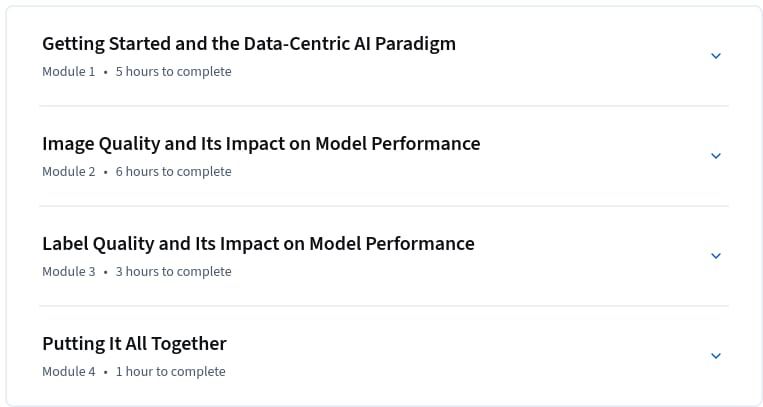
The course is organized into 4 modules. You will begin with the data-centric AI paradigm, the data and model feedback loop for object detection and instance segmentation, FiftyOne, and common evaluation metrics. You will then analyze dataset statistics and image quality, detect outliers and duplicate or near-duplicate images, examine semantic scores and scene diversity, and develop data-centric AI strategies. Next, you will assess annotation quality, handle mislabeled data, hard samples, overlapping detections, occlusions, and small objects, and use CVAT, FiftyOne, SAHI, and data augmentation techniques. Finally, you will apply advanced data-centric AI techniques such as data augmentation and active learning, implement an end-to-end iterative model-improvement workflow with FiftyOne, maintain dataset quality over time, and apply techniques to improve model performance on a given dataset.
What you’ll learn
- Describe the data-centric AI paradigm and explain its importance in modern deep learning workflows.
- Apply FiftyOne to evaluate model performance for object detection and instance segmentation and interpret common evaluation metrics.
- Analyze dataset statistics and image quality, and identify outliers, duplicates, near duplicates, and diversity issues.
- Assess annotation quality and identify common labeling problems, including mislabeled data, hard samples, overlapping detections, occlusions, and small objects.
- Use tools such as FiftyOne, CVAT, and SAHI for dataset exploration, annotation refinement, error correction, and visual AI data workflows.
- Apply data augmentation and active learning techniques to improve model robustness, generalization, and performance.
- Implement an end-to-end iterative workflow for model improvement and develop strategies for maintaining dataset quality over time.
Who this course is for
- Intermediate-level learners interested in data-centric AI and visual AI applications.
- Machine learning and computer vision practitioners who want to improve the quality of datasets used for model training and evaluation.
- Data scientists, ML engineers, and AI practitioners working with object detection, instance segmentation, and image datasets.
- Learners who want hands-on experience with tools such as FiftyOne, CVAT, and SAHI for dataset exploration, annotation, quality improvement, and model evaluation.
Specificatoin of Hands-on Data Centric Visual AI
- Publisher : Coursera
- Teacher : Harpreet Sahota
- Language : English
- Level : Intermediate
- Number of Course : 4
- Duration : 2 weeks to complete at 10 hours a week
Content of Hands-on Data Centric Visual AI
Pictures

Sample Clip
Installation Guide
Extract the files and watch with your favorite player
Subtitle : English
Quality: 720p
Download Links
Password file(s): www.downloadly.ir
File size
1.78 GB