


Descriptions
Prompt Engineering Frameworks & Methodologies, If you are a developer, data scientist, AI product manager, or anyone driven to unlock the full power of large language models, this course is designed for you. Ever asked yourself, “Why does my AI model misunderstand my instructions?” or “How can I write prompts that consistently get optimal results?” Imagine finally having the confidence to guide LLMs with precision and creativity, no matter your project. Prompt Engineering Frameworks & Methodologies offers a deep dive into practical, cutting-edge techniques that go far beyond basic AI interactions. This course equips you to systematically design, evaluate, and tune prompts so you reliably unlock the most capable, nuanced outputs – whether you’re building chatbots, automating workflows, or summarizing complex information. This course stands apart with its comprehensive, methodical approach—grounded in the latest LLM research and hands-on industry application. Whether you’re aiming to optimize a single task or architect complex multi-step workflows, you’ll gain practical frameworks and actionable methodologies proven to work across the latest LLMs.
What you’ll learn
- Discover the core principles of prompt engineering and why structured prompting leads to more consistent LLM outputs
- Explore best practices and reusable templates that simplify prompt creation across use cases
- Master foundational prompting frameworks like Chain-of-Thought, Step-Back, Role Prompting, and Self-Consistency.
- Apply advanced strategies such as Chain-of-Density, Tree-of-Thought, and Program-of-Thought to handle complex reasoning and summarization tasks.
- Design effective prompts that align with different task types—classification, generation, summarization, extraction, etc.
- Tune hyperparameters like temperature, top-p, and frequency penalties to refine output style, diversity, and length.
- Control model responses using max tokens and stop sequences to ensure outputs are task-appropriate and bounded.
- Implement prompt tuning workflows to improve model performance without retraining the base model.
- Evaluate prompt effectiveness using structured metrics and tools like PromptFoo for A/B testing and performance benchmarking.
Who this course is for
- AI developers who want to design more accurate and consistent prompts for language models.
- Product managers who want to improve the performance and reliability of GenAI features in their applications.
- Data analysts who want to extract better insights from LLMs using structured and optimized prompts.
- Prompt engineers and hobbyists who want to go beyond trial-and-error and use proven prompting methodologies.
- Researchers interested in exploring the frontiers of LLM prompting techniques and methodologies.
- Technical writers or content creators intent on crafting better AI-assisted workflows and automations.
Specificatoin of Prompt Engineering Frameworks & Methodologies
- Publisher : Udemy
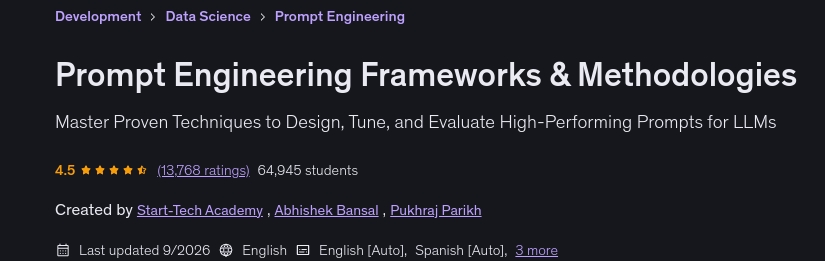
- Teacher : Start-Tech Academy , Abhishek Bansal , Pukhraj Parikh
- Language : English
- Level : All Levels
- Number of Course : 28
- Duration : 3 hours and 10 minutes
Content of Prompt Engineering Frameworks & Methodologies
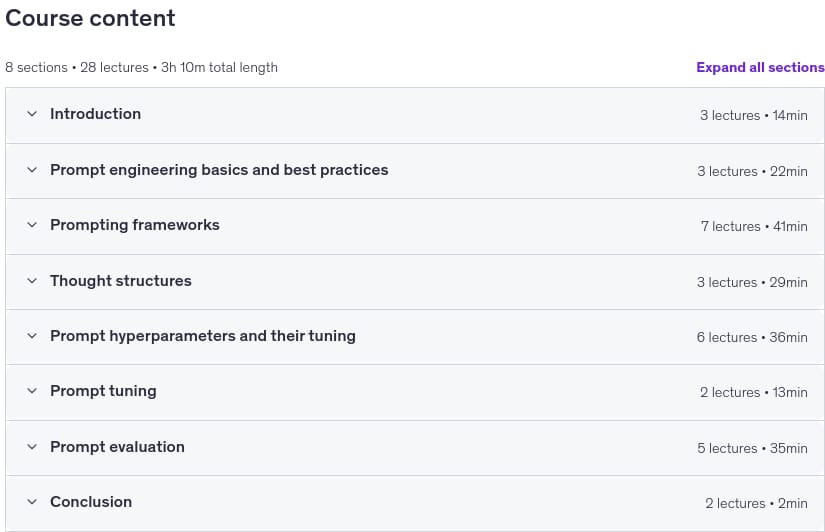
Requirements
- No prior experience or technical skills are required—just bring your curiosity, a computer with internet access, and an interest in exploring AI prompting.
Pictures
Sample Clip
Installation Guide
Extract the files and watch with your favorite player
Subtitle : English
Quality: 720
Download Links
Password file(s): www.downloadly.ir
File size
839 MB