

Description
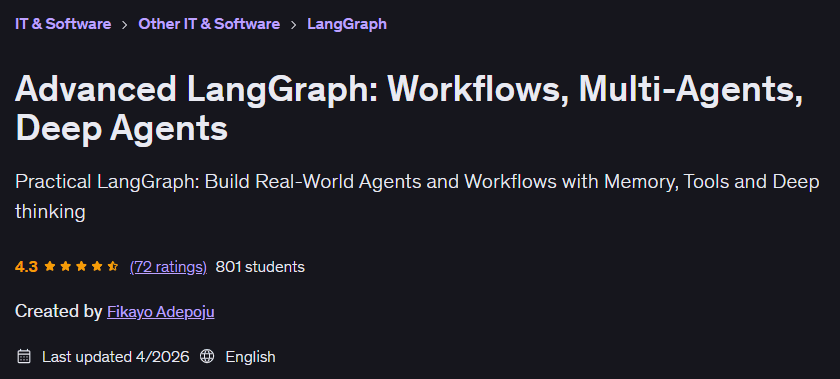
Advanced LangGraph: Workflows, Multi-Agents, Deep Agents. This advanced course teaches you how to design and implement agent-based AI workflows, multi-agent systems, and deep agents using the LangGraph library. This specialized course is designed as a comprehensive guide for developers who want to move beyond the limitations of linear AI chains and enter the era of agent-based workflows. While basic applications based on large language models often suffer from brittleness and lack of state management, this course provides learners with the architectural patterns necessary to build highly advanced, flexible, and autonomous systems. The learning process moves beyond simple question-and-answer cycles and into the world of adversarial graphs, where AI doesn’t just respond, but also reasons, remembers, and collaborates. Throughout this learning path, the core concepts and fundamental mechanics of LangGraph are thoroughly explored and quickly scaled to complex workflow architectures. Participants master the art of state management and learn how to give agents human-like memory across sessions by implementing short-term and long-term persistence. The course goes beyond building single agents, but also engineers multi-agent systems that use subgraphs to decompose logic and solve problems at an enterprise scale. Finally, the boundaries of deep agents are explored and learners are taught how to build recursive, long-running systems that can automatically schedule, self-heal, and execute multi-step tasks with minimal human intervention. In addition, the course’s technical topics cover deep concepts such as advanced data management, building collaborative ecosystems across different models, and deploying stateful and reliable systems. Developers learn how to manage the heterogeneity of real-world data and user interactions and scale their AI development from simple scripts to enterprise architectures. This curriculum provides all the tools and mindsets necessary to enable engineers to orchestrate and manage a highly efficient, integrated workforce of large language models.
What you will learn
- Mastering Longgraph Fundamentals: Establish a solid foundation in states, nodes, and edges to transition from linear chains to rotation-oriented and agent-oriented workflows.
- Designing advanced workflows: Architecting complex state machine patterns to manage complex business logic and nonlinear AI reasoning paths.
- Short-term memory implementation: Using topic-level persistence to maintain context and state throughout a single user session or conversation.
- Long-term persistence management: Empowering agents to recall information across multiple sessions by integrating robust, long-term memory storage solutions.
- Coordination of multi-agent systems: Building collaborative ecosystems where specialized agents interact with each other through subgraphs to solve high-level organizational tasks.
- Deep agent engineering: Developing long-term, recursive agents that have the ability to autonomously plan, correct errors, and perform complex tasks.
This course is suitable for people who:
- AI Engineers: Experts who have mastered the basic chains and are ready to build complex, stateful, agent-based architectures.
- Backend developers: People looking to implement reliable, multi-step AI workflows with strong memory management and persistence capabilities.
- Technical Architects: Designers who need to design collaborative multi-agent systems with scalability at the enterprise task level.
Advanced LangGraph Course Details: Multi-Agents Deep Agents Workflows
- Publisher: Udemy
- Instructor: Fikayo Adepoju
- Training level: Beginner to advanced
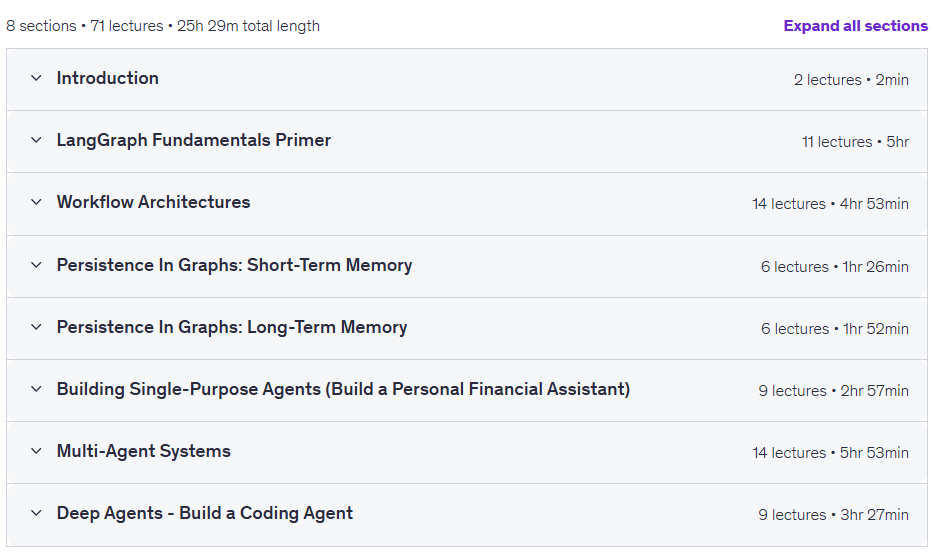
- Training duration: 25 hours and 29 minutes
- Number of lessons: 71
Course headings
Advanced LangGraph: Multi-Agents Deep Agents Workflows Course Prerequisites
- Intermediate Python Proficiency: You must be comfortable with Type Annotations, TypedDicts, and asynchronous programming in Python.
- LangChain Fundamentals: Pre-existing knowledge of LLMs, Prompt Templates, and the LangChain Expression Language (LCEL) is essential.
- Basic Agent Understanding: Familiarity with the basic “ReAct” agent pattern and how LLM tool-calling works will be necessary to follow the advanced modules.
- Environment Setup: A local development environment with Python 3.10+ installed and the ability to manage API keys for providers like OpenAI or Anthropic.
Course images
Sample course video
Installation Guide
After Extract, view with your favorite player.
Subtitles: None
Quality: 1080p
Download link
Rapidgator link
File(s) password: www.downloadly.ir
File size
14.3 GB