

Description
Embedded Systems Cellular Firmware Development (GSM) course. This course teaches the development of mobile and cellular firmware systems for microcontrollers in order to add mobile network connectivity to embedded devices. This specialized course teaches engineers and programmers how to develop the necessary drivers and libraries to add cellular and communication capabilities to embedded devices. This course uses the STM32 microcontroller and the GSM/GPRS model A6 chip, which is a low-cost, quad-band chip that supports global communication bands. The drivers developed in this course can be used on almost all cellular chips on the market due to the use of UART communication. The structure of this course is divided into three main parts. The first part focuses on theoretical topics, concepts of cellular technologies, and principles of GSM architecture. In the second part, bare-metal drivers are developed to interface the A6 chip to the STM32 microcontroller, and efficient data structures are implemented to manage communications. In the final part, the drivers and data structures are combined to create a complete library for connecting to the cellular network and implementing real-world projects such as sending SMS, making calls, and transmitting sensor data. In addition, participants in this course learn how to fully understand basic concepts such as SIM card operation, the differences between different generations of telecommunication networks including 1G to 5G, and the differences between communication technologies such as GSM, LTE, and WCDMA. This course provides the practical skills necessary to design and implement network-connected hardware systems, allowing developers to control their hardware automatically and through time-based events or alarms.
What you will learn
- Introduction to Cellular Technologies: A thorough understanding of the fundamentals and principles of telecommunications technologies and mobile networks.
- Comprehensive library development: Building a complete library for using cellular chips with STM32 microcontrollers.
- Data structure management: Implementation of a queue data structure (FIFO) for efficient management of communication data between the chip and the microcontroller.
- Hardware control with SMS: Development of low-level firmware to control hardware modules by sending SMS.
- Hardware control by phone: Programming to control hardware modules and equipment by making phone calls.
- Automation with hardware triggers: Develop firmware to automatically send SMS or make calls using hardware triggers.
- Send sensor data with alarm: Programming to automatically send sensor data as soon as a real-time clock (RTC) alarm occurs.
- Periodic data sending: Regular and periodic sending of sensor data via the system’s real-time clock.
- Real-time clock driver development: Building low-level drivers for time management in embedded systems.
This course is suitable for people who:
- Embedded systems developers: Programmers working in the field of hardware and microcontrollers who want to add cellular connectivity to their devices.
- Hardware and firmware engineers: People looking to learn the principles of implementing drivers and serial communications in industrial and applied projects.
- IoT enthusiasts: Professionals who want to connect their smart devices to mobile networks and the global internet.
Embedded Systems Cellular Firmware Development (GSM) Course Specifications
- Publisher: Udemy
- Lecturer: BHM Engineering Academy , Israel Gbati
- Training level: Beginner to advanced
- Training duration: 10 hours
- Number of lessons: 48
Course headings
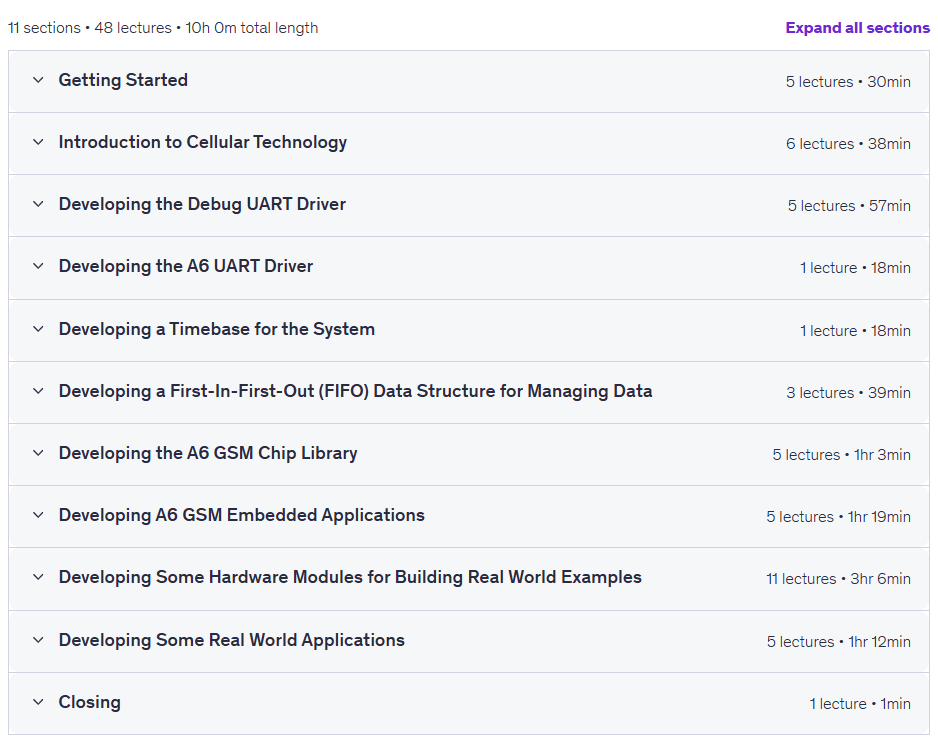
Prerequisites for the Embedded Systems Cellular Firmware Development (GSM) course
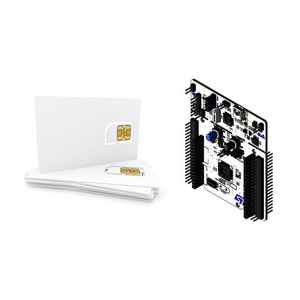
- NUCLEO-STM32F411 DEVELOPMENT BOARD
- A6 GSM/GPRS Module
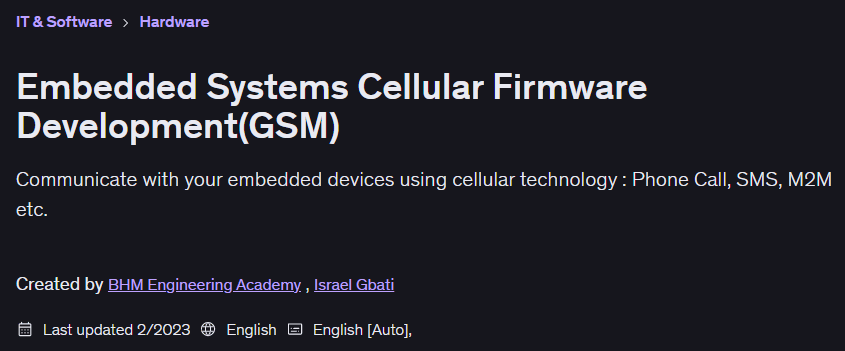
Course images
Sample course video
Installation Guide
After Extract, view with your favorite player.
Subtitles: English
Quality: 1080p
Download link
Rapidgator link
File(s) password: www.downloadly.ir
File size
5.2 GB