

Description
“AI Engineering 2026: ML, Deep Learning, LLMs, RAG & Agents” is a training course on the design, development, and deployment of modern AI applications, published by the online academy Udemy. This comprehensive course covers the fundamental technologies driving today’s rapidly evolving AI landscape. You will explore the foundations of machine learning and deep learning, understand how neural networks learn from data, and discover how these techniques power intelligent systems across various industries. You will delve into Large Language Models (LLMs) and learn to work with generative AI technologies through prompt engineering, model integration, and application development.
The course examines Retrieval-Augmented Generation (RAG), explaining how embeddings, vector databases, and information retrieval techniques enable AI applications to access external knowledge and provide context-aware responses. You will discover how to build intelligent AI agents capable of reasoning, interacting with external tools, managing information, and executing multi-step workflows. You will gain an understanding of the entire AI engineering lifecycle, including data preparation, model development, evaluation, integration, and deployment. Whether you are a software developer, data scientist, machine learning specialist, or an aspiring AI engineer, this course offers a valuable learning path to acquire practical expertise in machine learning, deep learning, LLM-based applications, RAG architectures, and autonomous AI systems.
What you will learn in AI Engineering 2026: ML Deep Learning LLMs RAG & Agents:
- Build, train and evaluate machine learning models in Python with pandas and scikit-learn, from cleaning raw data to reading a confusion matrix
- Choose the right algorithm for a problem: regression, classification, decision trees, random forests, XGBoost, SVMs and k-means clustering
- Diagnose overfitting and underfitting and fix them with regularization, cross-validation and better features
- Understand how neural networks learn and train your own in PyTorch and Keras, including CNNs for computer vision
- Explain how LLMs work: tokens, embeddings, attention, transformers, context windows, quantization and mixture-of-experts
- and …
Course specifications
Publisher: Udemy
Instructors: Phani Avagaddi
Language: English
Level: Introductory to Advanced
Number of Lessons: 211
Duration: 39h 53m
Course topics
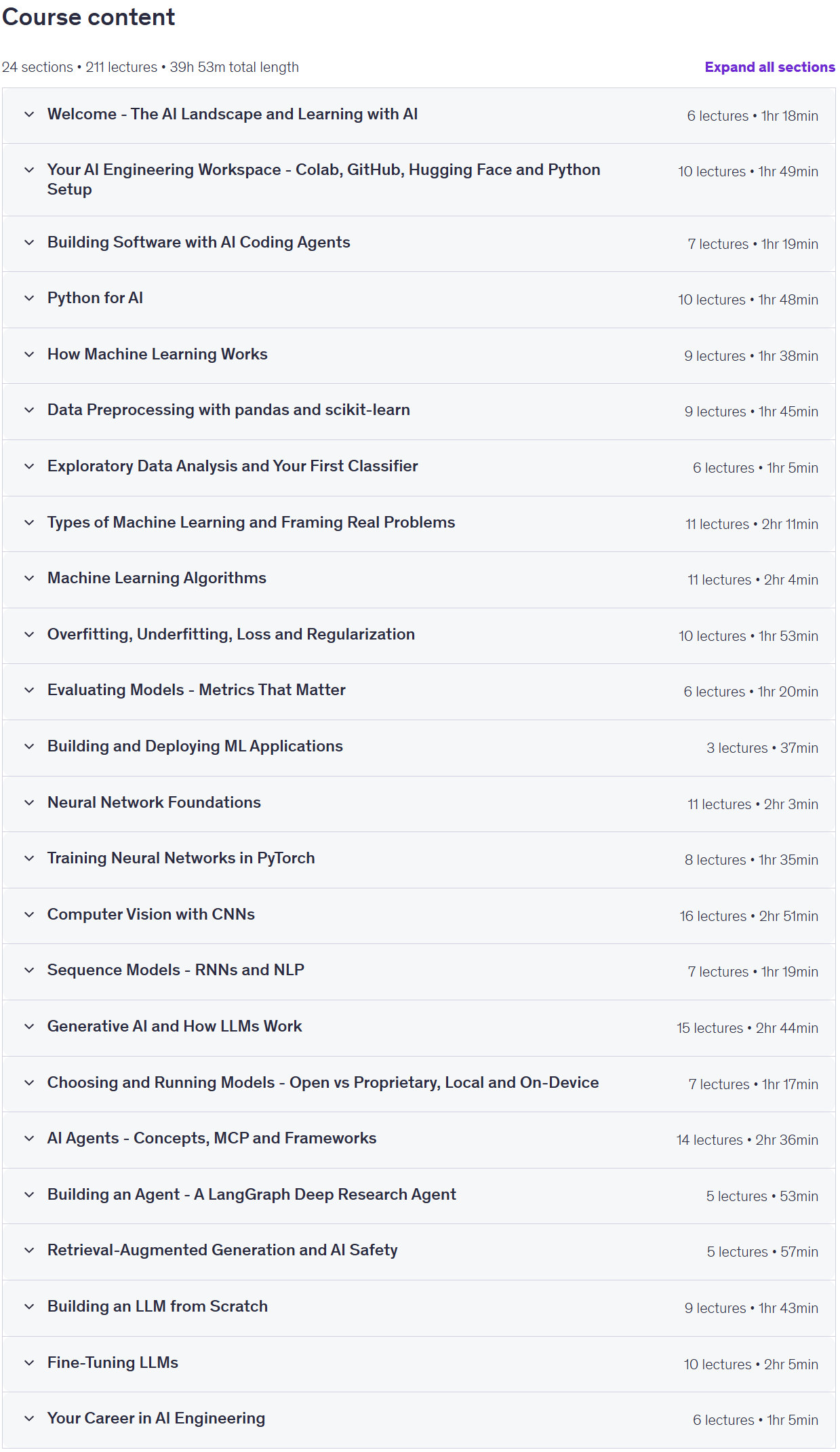
AI Engineering 2026: ML Deep Learning LLMs RAG & Agents Prerequisites
No prior AI or machine learning experience needed. Python is taught from scratch, focused on what you need for AI.
A computer with internet access and a free Google account for Google Colab. No GPU or paid cloud account required.
High-school math is enough. The math you need (vectors, matrices, gradients) is explained when it comes up.
Optional: a ChatGPT, Claude or Gemini subscription helps in the coding-agent lectures, but free alternatives are covered too.
Pictures
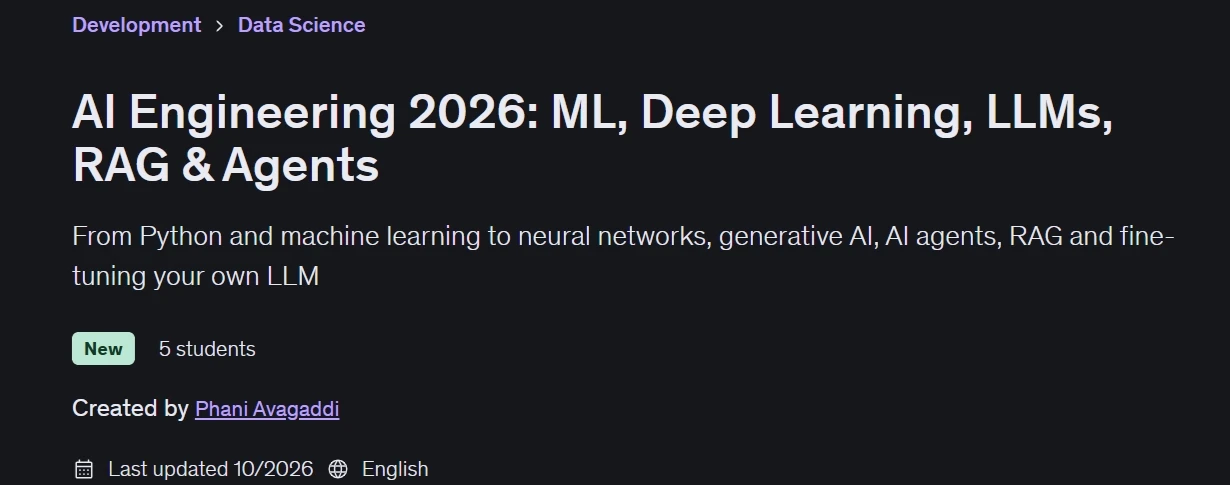
AI Engineering 2026: ML Deep Learning LLMs RAG & Agents introduction video
Installation guide
After Extract, watch with your favorite Player.
Subtitle: None
Quality: 1080p
Downloadly link
Rapidgator link
File password (s): www.downloadly.ir
Size
32.5 GB