


Description
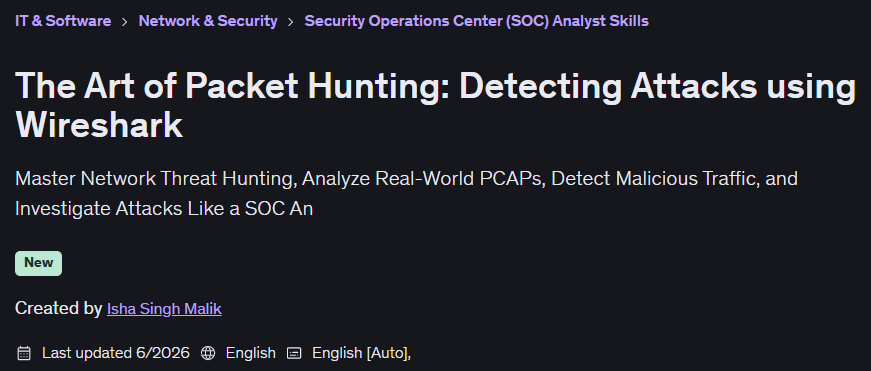
The Art of Packet Hunting: Detecting Attacks using Wireshark. This course explores how to analyze network traffic, identify suspicious behavior, and detect cyberattacks using Wireshark for defense and SOC activities. Network traffic tells a story in which attackers leave their footprints, and security professionals need to know how to find these signs. The Art of Packet Hunting is a practical, research-based security training course designed to teach you how to analyze network traffic, detect suspicious behavior, and detect attacks using Wireshark. In this learning path, instead of simply learning Wireshark as a typical packet analyzer, participants learn how security analysts use the software as an effective weapon to hunt for threats in real-world environments. During this course, learners will learn the basics of threat hunting, the mindset of a Security Operations Center (SOC) analyst, the Wireshark workflow for security audits, protocol analysis, and network traffic inspection. The main topics covered in this course are examining DNS traffic and identifying suspicious domain activity, analyzing HTTP traffic and discovering malicious communications, identifying malware and command and control (C2) server communications, and investigating data leaks through network traffic. Students will work with practical scenarios and PCAP files to understand how attackers communicate, how malicious activity hides in normal traffic, and how to uncover these hidden patterns. By the end of the course, individuals will be able to confidently analyze PCAP files, investigate suspicious activity, detect malicious communication patterns, extract indicators of contamination (IOCs), and build a structured threat hunting workflow to think like a true SOC analyst during an investigation.
What you will learn
- Threat Hunting Basics: Understanding threat hunting concepts, comparing reactive and proactive approaches, and cultivating a threat hunter mindset.
- Identifying and discovering threats: Using specialized tools and methods to discover threats on the network.
- Working with Wireshark: Installation tutorial in Kali, understanding the user interface, initial settings, packet capture concepts and flow analysis.
- Examine packet details and bytes: Analyze network conversations and use essential Wireshark filters.
- Network communications: TCP/IP traffic analysis, source and destination inspection, and protocol inspection.
- TCP and HTTP handshake analysis: Distinguishing normal versus abnormal traffic and identifying suspicious packets.
- DNS traffic analysis: Identify suspicious domains, detect DNS tunneling, and domain indices.
- HTTP request and response analysis: examining GET and POST methods and identifying web-based attacks.
- Malware and C2 communications: Identify malware communication signals (beaconing), control server traffic, and data leaks.
- PCAP file analysis: Examine network behavior for malware, large data transfers, and suspicious outgoing traffic.
- Real-world case studies: Explore real-world scenarios and create custom workflows for threat hunters.
This course is suitable for people who:
- Beginners, students, and cybersecurity enthusiasts: People who want to start learning network security from the ground up.
- Beginner and aspiring SOC analysts: Those who plan to work in security operations centers.
- Security analysts and Blue Team specialists: Individuals looking to enhance their defensive skills.
- Incident Responders: Professionals who work in the early stages of investigating cyber incidents.
- Network security specialists and system administrators: Individuals responsible for maintaining the security of network infrastructure.
- Regulatory hackers, penetration testers, and vulnerability hunters: professionals who want to better understand the footprint of attacks.
- Red Team members and security researchers: People who seek to understand defensive methods.
- Computer Science and Engineering Students: People who wish to enter the world of cybersecurity.
- Threat and malware intelligence analysts: Specialists who examine network traffic for malware.
- Emerging Digital Forensics professionals: Those who need to analyze network packets.
- Security engineers, network and firewall administrators: People who control and monitor network traffic.
Course Details The Art of Packet Hunting: Detecting Attacks using Wireshark
- Publisher: Udemy
- Instructor: Isha Singh Malik
- Training level: Beginner to advanced
- Training duration: 2 hours and 30 minutes
- Number of lessons: 15
Course topics

Prerequisites for The Art of Packet Hunting: Detecting Attacks using Wireshark
- No prerequisites needed. All the information required is included in the course. From installation of basic tools required to advanced.
Course images
Sample course video
Installation Guide
After Extract, view with your favorite player.
Subtitles: None
Quality: 1080p
Download link
Rapidgator link
File(s) password: www.downloadly.ir
File size
1.4 GB