

Description
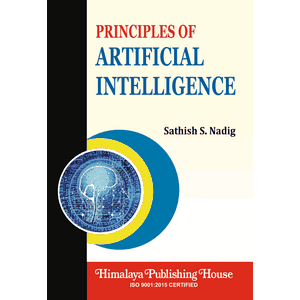
Principles of Artificial Intelligence explores the theoretical foundations and structural models of artificial intelligence and attempts to explain the scientific underpinnings of this transformative technology to researchers and engineers. Taking a logical, step-by-step approach, the author first introduces the audience to basic concepts such as knowledge representation, state search spaces, and rule-based systems. In this work, artificial intelligence is depicted not as a magical and sudden phenomenon, but as an evolution of computer science, mathematics, and formal logic. The book extensively examines classical search algorithms, automated programming, and how to model complex problems in a way that can be understood and solved by machines, and it builds a very strong foundation for understanding modern intelligent systems.
The book then moves on to more modern areas such as machine learning, artificial neural networks, and natural language processing. The author explains how machines can discover hidden patterns through experience and data analysis and optimize their performance without the need for explicit programming. In addition to the technical aspects, the book also pays special attention to the philosophy of mind, the nature of intelligence, and the social and ethical implications of developing autonomous systems. This valuable work, due to its excellent balance between deep mathematical theories and practical computer applications, is a standard textbook for computer science students and a comprehensive guide for professionals who want to take a principled view of artificial intelligence beyond superficial tools.
Book Features
- A structured explanation of the logical, mathematical, and algorithmic principles governing classical and modern artificial intelligence systems.
- Comprehensive coverage of topics such as automated inference, problem solving, knowledge representation, and search space optimization.
- A thorough introduction to machine learning, deep neural networks, and supervised and unsupervised learning methods.
- Exploring the philosophical challenges surrounding artificial general intelligence (AGI) and ethical considerations in algorithm design.
Book specifications
- Publisher: Himalaya Publishing House
- Instructor/Author: Sathish S. Nadig
- Number of pages: 198
- Number of chapters: 7
- Format: PDF
Headlines

Pictures

User Guide
Extract the file and run it with the appropriate software.
Download link
File(s) password: www.downloadly.ir
File size
3.8 MB