

Description
“Build an Autonomous Underwater ROV: ROS 2, Gazebo, and ArduSub” is a course published by the online academy Udemy, focused on building an autonomous underwater Remotely Operated Vehicle (ROV) using a combination of ROS 2, Gazebo, and ArduSub. This course introduces essential concepts in underwater robotics and guides you through the software tools used to build and control robotic vehicles within simulated underwater environments. You will explore how ROS 2 facilitates communication between robotic components, how Gazebo supports physics-based simulation, and how ArduSub manages vehicle control and navigation. You will gain insights into configuring robotic systems, integrating sensors, testing vehicle behavior, and developing the foundations for autonomous underwater movement. Through these technologies, you will learn how simulation enables engineers to evaluate robotic designs, troubleshoot control systems, and test navigation strategies before deploying hardware in real-world environments. You will grasp the fundamentals of underwater robotics and ROV development, while examining ROS 2 concepts such as nodes, topics, services, and robotic communication. Furthermore, you will learn to use Gazebo to simulate underwater robotic environments and discover the role of ArduSub in controlling an underwater vehicle.
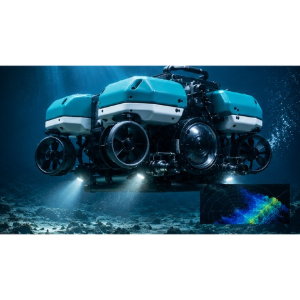
You will build and simulate an underwater ROV from scratch using ROS 2, Gazebo Harmonic, ArduSub, and QGroundControl—all without the need for any physical hardware. You will pilot a BlueROV2-class vehicle within a simulation environment, managing thruster controls, flight modes, depth-holding, and ArduSub parameter configuration via QGroundControl. You will work with underwater sensors—including cameras, IMUs, depth/pressure sensors, and forward-looking sonar—while visualizing and recording live data using RViz and rosbag2. You will create 3D sonar maps and train an AI-based computer vision model to detect underwater targets, ultimately integrating these elements into an autonomous inspection mission. You will configure and test a simulated underwater ROV, explore sensor integration and inter-component communication, and gain an understanding of vehicle motion, control systems, and navigation. Furthermore, you will practice simulation-based testing, debugging, and performance evaluation. Whether you are a robotics enthusiast, an engineering student, or a developer interested in autonomous systems, this course offers a hands-on introduction to underwater ROV development and the integration of modern robotics software, laying a solid foundation for advanced autonomous robotics projects and underwater exploration.
What you will learn in Build an Autonomous Underwater ROV: ROS2 Gazebo ArduSub:
- Build and simulate an autonomous underwater ROV from scratch using ROS2, Gazebo Harmonic, ArduSub, and QGroundControl — no hardware required
- Pilot a BlueROV2-class vehicle in simulation: thruster control, flight modes, depth hold, and tuning ArduSub parameters through QGroundControl
- Work with underwater sensors — camera, IMU, depth/pressure, and forward sonar — visualizing and recording live data in RViz and rosbag2.
- Build 3D sonar mapping and train an AI vision model to detect underwater targets, then fuse it all into one autonomous inspection mission
- and …
Course specifications
Publisher: Udemy
Instructors: Frank Robotics Lab
Language: English
Level: Introductory to Advanced
Number of Lessons: 87
Duration: 3 hours and 51 minutes
Course topics

Build an Autonomous Underwater ROV: ROS2 Gazebo ArduSub Prerequisites
Comfortable reading Python: functions, classes, and a traceback. You do not need to be an expert
Pictures

Build an Autonomous Underwater ROV: ROS2 Gazebo ArduSub introduction video
Installation guide
After Extract, watch with your favorite Player.
Subtitle: None
Quality: 1080p
Downloadly link
Rapidgator link
File password (s): www.downloadly.ir
Size
2 GB