
Description
Introduction to Modern Python Programming. This course is a comprehensive and modern program for learning the Python programming language, designed from beginner to advanced levels, and helps learners gain a deep understanding of how the language works and write clean, standard code. This course is designed as a comprehensive and modern reference for learning the Python programming language from scratch, and no previous prerequisites are required to participate. The educational process is structured in such a way that, instead of superficial and hasty learning of the grammar, the learner forms an accurate mental model of how Python actually works. This goal is reinforced by the use of educational slides, live programming, and practical exercises at the end of each chapter. The course topics begin with basic concepts; including setting up a professional development environment with tools such as VS Code, Kenda, and Jupyter, using Python as a calculator, and mastering control flow using conditional statements and loops. The course then moves on to Python’s core data structures, including strings, lists, tuples, dictionaries, and collections, before delving into more advanced topics such as functions with default arguments, closures, and functional tools such as map, filter, and lambda. The second part of the course focuses on the skills that make the difference between beginner and advanced Python programmers, including decorators, object-oriented programming including classes, special methods, inheritance, and abstract classes, as well as practical skills needed for real-world, high-impact projects, such as error handling, file input and output, and context management, and how modules, namespaces, and scopes work in Python. All chapters include multiple-choice questions and programming challenges with full answers so that the learner can immediately assess their learning. By the end of this course, learners will not only be familiar with Python syntax, but also understand the reasons for Python’s behavior in different situations and will be ready to write clean, well-structured, and high-quality code for production environments. The slides presented in this course are generated using artificial intelligence and based on the topics, tips, and content written by the instructor, and all the code, exercises, and explanations are completely original and belong to the instructor. This program provides a modern and standard scientific foundation for beginners or people migrating to Python from other languages.
What you will learn
- Effectively write and execute Python code from beginner to intermediate to advanced levels.
- Setting up a professional, real-world development environment for Python programming
- Master Python’s built-in data structures including lists, tuples, dictionaries, collections, and understand the concept of object mutability and identity.
- Write clean, reusable functions including advanced patterns such as variable arguments, closures, and decorators
- Building object-oriented programs using classes, special methods, and the inheritance mechanism
- Securely read and write files and organize larger programs using modules, packages, namespaces, and access domains.
This course is suitable for people who:
- Complete beginners with no programming experience looking for a practical foundation in Python
- Curious minds include programmers who already have some familiarity with Python but want to understand how it works behind the scenes.
- Language migrants include developers who have come to Python from other programming languages.
- AI-reliant programmers are people who primarily use AI tools to generate code and want to understand the actual meaning and functionality of that code.
Course details Introduction to Modern Python Programming
- Publisher: Udemy
- Lecturer: Dr. Pietropaolo Frisoni
- Training level: Beginner to advanced
- Training duration: 12 hours and 43 minutes
Course syllabus as of 2026/9
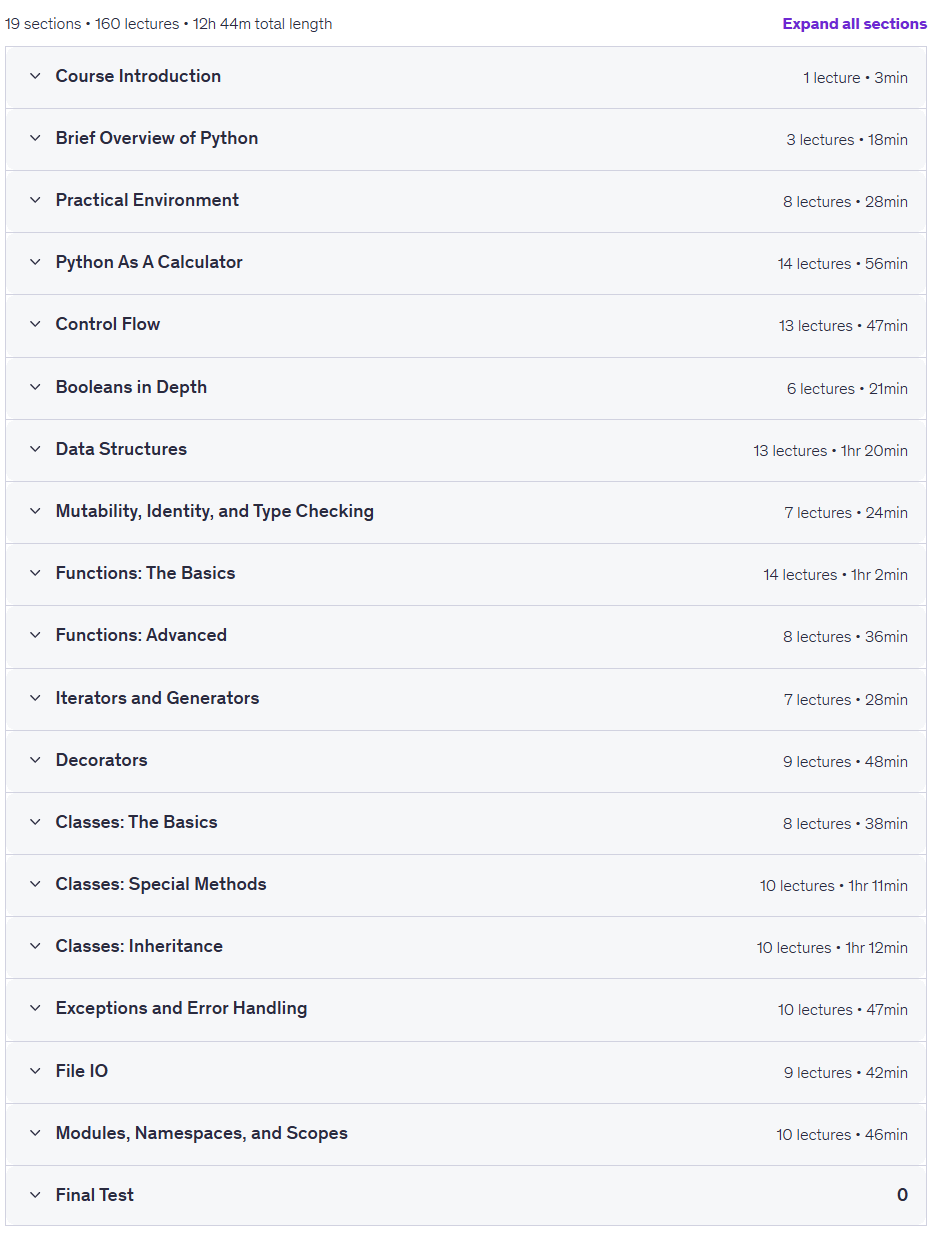
Prerequisites for the Introduction to Modern Python Programming course
- No prior programming experience required. This course starts from scratch
- A computer (Windows, macOS, or Linux) able to install free, open-source tools. Full setup instructions are included in the course
- Curiosity and willingness to practice (the notebooks are meant to be run and experimented with)
Course images
Sample course video
Installation Guide
After Extract, view with your favorite player.
Subtitles: None
Quality: 1080p
Download link
Rapidgator link
File(s) password: www.downloadly.ir
File size
4.9 GB