


Description
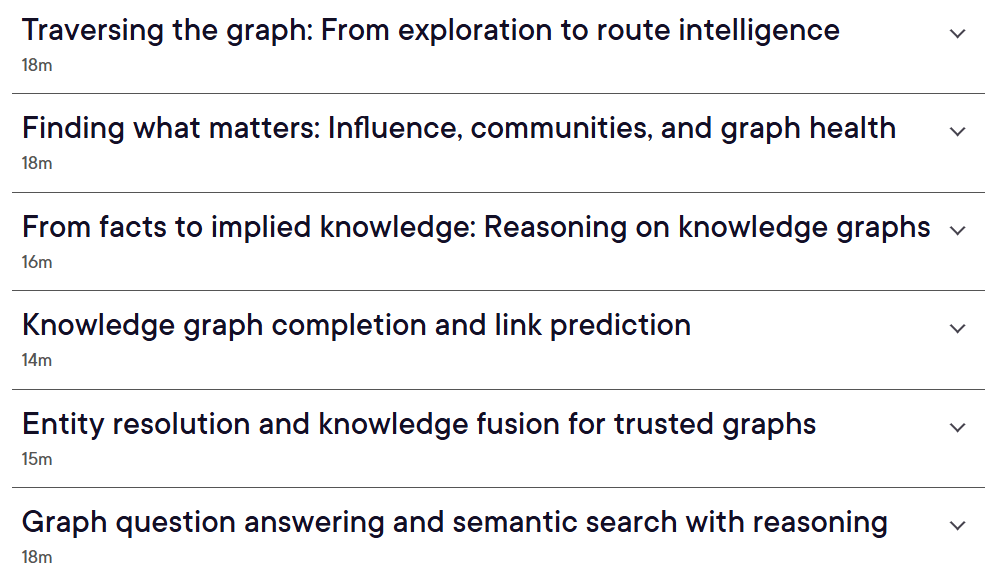
Knowledge Graph Algorithms and Reasoning. This course explores advanced algorithms and reasoning techniques on knowledge graphs to build smarter applications and analyze connected data. Knowledge graphs are recognized as a powerful foundation for AI systems, but their true value lies beyond the data they store, in discovering hidden patterns within them. In this specialized course, learners learn how to use algorithms and reasoning techniques to transform interconnected data into actionable information for search engines, recommender systems, and generative AI-based experiences. The first part examines how to navigate knowledge graphs using breadth-first search (BFS) and depth-first search (DFS), apply shortest path techniques such as Dijkstra and A* to weighted relationships, and analyze joins and loops. Next, graph structure analysis using centrality measures and community detection to identify influential entities, clusters, and anomalies is taught. The final section discusses reasoning on knowledge graphs using RDFS and OWL semantics, choosing between forward chaining and query rewriting, and implementing graph completion, entity resolution, and graph-based response. Upon completion of this course, participants will have acquired the skills necessary to navigate, analyze, and reason on knowledge graphs to build more accurate and scalable AI systems. In addition, the course helps AI developers and engineers manage complex data structures more efficiently. By mastering logical reasoning methods, systems will be able to extract new inferred truths from existing data, which plays a significant role in optimizing the performance of large language models. This training provides a structured approach to solving data quality and information integration challenges and provides professionals with the tools necessary to implement advanced semantic search.
What you will learn
- Navigating knowledge graphs: Learning how to navigate the graph using depth-first and surface-first search algorithms.
- Calculating the shortest path: Applying Dijkstra and A* algorithms on weighted relations for connectivity and accessibility analysis.
- Graph structure analysis: Using centrality and community detection measures to identify key entities and hidden patterns.
- Logical Reasoning: Applying RDFS and OWL semantics to extract implicit facts and reason on data.
- Graph completion and entity separation: Implementing functional pipelines to fix graph imperfections and integrate information.
- Designing semantic query and search systems: Building intelligent graph-based systems to answer complex questions and improve artificial intelligence performance.
This course is suitable for people who:
- Artificial Intelligence Engineers: Professionals who aim to improve AI-based systems using knowledge graphs.
- Data developers and software engineers: People who work with graph databases and connected data structures.
- Researchers and data analysts: Those who seek to analyze complex patterns, cluster, and discover knowledge from structured data.
- Intelligent Systems Architects: Designers who want to implement semantic search and logical reasoning capabilities in their projects.
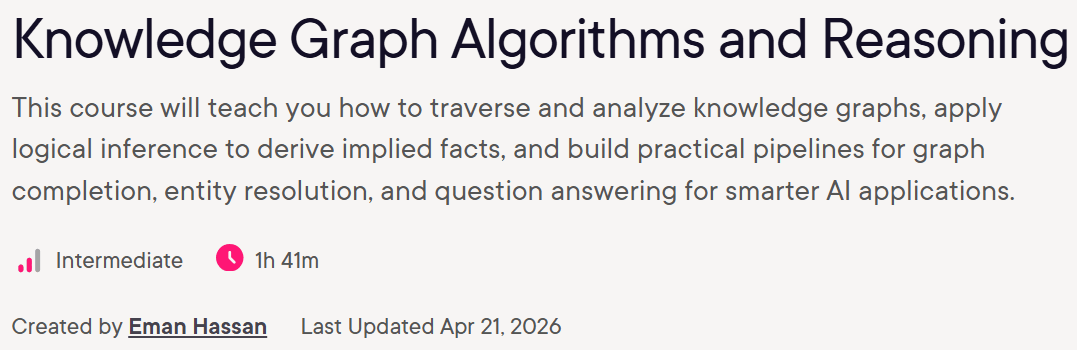
Knowledge Graph Algorithms and Reasoning Course Specifications
- Publisher: Pluralsight
- Instructor: Eman Hassan
- Education level: Intermediate
- Training duration: 1 hour and 41 minutes
Course headings
Course images
Sample course video
Installation Guide
After Extract, view with your favorite player.
Subtitles: English
Quality: 720p
Download link
Rapidgator link
File(s) password: www.downloadly.ir
File size
169 MB