

Description
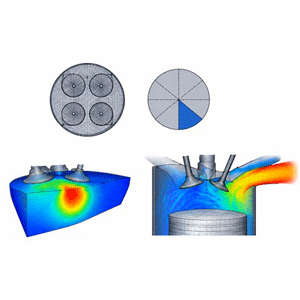
“Internal Combustion Engine CFD Simulation with ANSYS Fluent” is a training course on simulating and analyzing internal combustion engines using ANSYS Fluent, published by the online academy Udemy. The course introduces you to the world of Computational Fluid Dynamics (CFD), helping you understand how airflow, fuel injection, combustion, pressure, temperature, and other critical engine phenomena can be virtually modeled and analyzed—thereby replacing costly physical testing with reliable, simulation-based insights. Learners begin by grasping the operating principles of internal combustion engines and identifying the key components of a diesel engine, as well as the specific function of each part within the combustion cycle. This mechanical grounding is essential before proceeding to simulation, as a CFD model is only as meaningful as the engineer’s understanding of the actual physical processes occurring inside the engine. The course then covers engine geometry and valve timing, teaching learners how to construct precise engine geometry using both ANSYS SpaceClaim and SOLIDWORKS.
Accurately creating this geometry lays a fundamental groundwork, as the entire simulation relies on the precise modeling of the combustion chamber, valves, and surrounding components. The core of the course focuses on setting up an ICE simulation directly within ANSYS Fluent. Learners define key engine parameters—such as crank radius, connecting rod length, compression ratio, and valve lift profiles—and incorporate real-world mechanical specifications into the simulation configuration, rather than relying on generic default values. The course also covers the configuration of appropriate boundary and operating conditions, as well as the selection of the correct physical models to accurately represent combustion, fuel injection, and heat transfer. After correctly configuring a simulation, learners run it, interpret the results, and learn how to evaluate engine performance based on pressure, temperature, and flow data generated by the model. By the end of the course, learners will be able to set up, run, and analyze internal combustion engine CFD simulations in ANSYS Fluent, possessing a solid understanding of both the mechanical and computational aspects of the process.
What you will learn in Internal Combustion Engine CFD Simulation with ANSYS Fluent:
- Understand the working principles of internal combustion engines and identify the main components of a diesel engine and their functions.
- Understand engine geometry and valve timing and create an engine geometry in ANSYS SpaceClaim and SOLIDWORKS.
- Set up an ICE simulation in ANSYS Fluent and define engine parameters such as crank radius, connecting rod length, compression ratio, and valve lift profiles.
- and …
Course specifications
Publisher: Udemy
Instructors: Mahmoud Ahmed
Language: English
Level: Introductory to Advanced
Number of Lessons: 22
Duration: 6h 57m
Course topics

Internal Combustion Engine CFD Simulation with ANSYS Fluent Prerequisites
A basic understanding of Internal Combustion Engines (ICE) and the four-stroke diesel engine cycle.
Familiarity with engine components such as the piston, cylinder, valves, and fuel injector.
Basic knowledge of fluid mechanics and thermodynamics.
Pictures
Internal Combustion Engine CFD Simulation with ANSYS Fluent introduction video
Installation guide
After Extract, watch with your favorite Player.
Subtitle: None
Quality: 1080p
Downloadly link
Rapidgator link
File password (s): www.downloadly.ir
Size
5.1 GB