

Descriptions
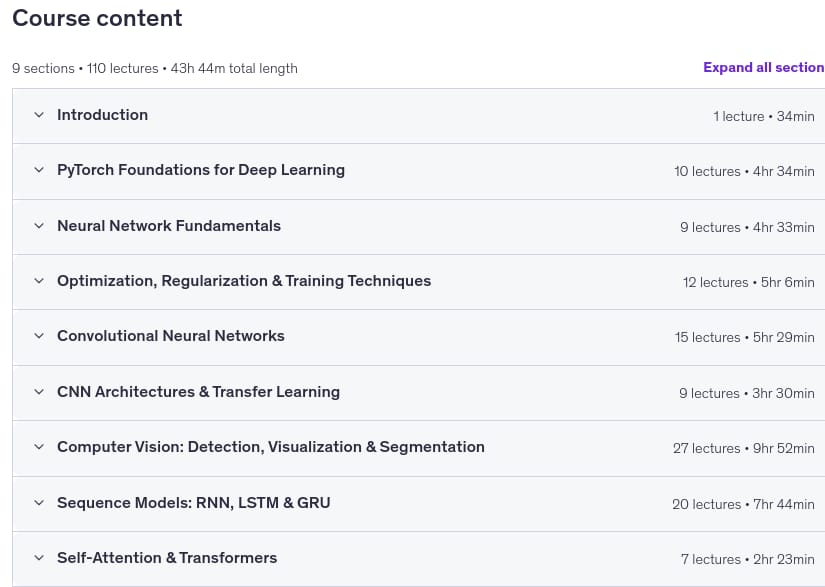
Complete Deep Learning Bootcamp with PyTorch, PyTorch Fundamentals: Tensors, computational graphs, Autograd, backpropagation, training loops, nn.Module, loss functions, optimizers, Dataset, and DataLoader. Neural Networks: Weights, biases, forward and backward propagation, activation functions, gradient descent, optimization, weight initialization, and loss functions. Regularization & Training: L1/L2 regularization, Dropout, Batch Normalization, Layer Normalization, Instance Normalization, and Early Stopping. Convolutional Neural Networks: Convolution, kernels, feature maps, padding, stride, pooling, CNN architectures, and data augmentation. Modern CNN Architectures: VGG, ResNet, DenseNet, MobileNet, and Transfer Learning. Computer Vision: Image classification, Grad-CAM, object detection, YOLO, and advanced image segmentation techniques. Image Segmentation: U-Net, Mask R-CNN, FCN, SegNet, DeepLab, PSPNet, HRNet, BiSeNet, SegFormer, and Transformer-based segmentation. Sequence Models: RNN, LSTM, GRU, Bidirectional RNNs, BiLSTM, BiGRU, Stacked RNNs, and Seq2Seq. Attention Mechanisms: Bahdanau Attention, Luong Attention, Global & Local Attention, and Self-Attention. Transformers: QKV, Multi-Head Attention, Transformer Architecture, Encoder, Decoder, Add & Norm, and Feed-Forward Networks.
Hands-On Projects: Build practical Deep Learning projects using PyTorch, real-world datasets, and modern Deep Learning architectures. Practical Learning: Learn through concepts, mathematics, implementation, coding, model training, and evaluation. By the end of this course, you will have a strong foundation in Deep Learning and practical experience building real-world neural networks and applications, computer vision systems, sequence models, and Transformer-based solutions using PyTorch.
What you’ll learn
- Build and train deep learning models with PyTorch, including tensors, Autograd, neural networks, loss functions, and optimizers.
- Understand and implement neural networks, CNNs, RNNs, LSTMs, GRUs, and modern Transformer architectures.
- Apply deep learning to real-world computer vision tasks, including image classification, object detection, and image segmentation.
- Build hands-on deep learning projects using PyTorch, transfer learning, YOLO, Grad-CAM, and advanced vision models.
- Understand attention, self-attention, QKV, multi-head attention, and the architecture of Transformer models.
- Apply optimization, regularization, normalization, weight initialization, and training techniques to improve model performance.
- Build sequence-based NLP solutions using RNN, LSTM, GRU, Seq2Seq, and attention mechanisms.
- Develop and evaluate end-to-end deep learning solutions using real-world datasets and practical model-building workflows.
Who this course is for
- Aspiring Data Scientists and Machine Learning Engineers who want to learn Deep Learning with PyTorch.
- Python developers who want to transition into Deep Learning and AI.
- Machine Learning professionals who want to strengthen their Deep Learning and Computer Vision skills.
- AI/ML students and beginners who want a structured, hands-on path from neural-network fundamentals to advanced architectures.
- Developers and professionals interested in Computer Vision, NLP, RNNs, LSTMs, Transformers, and Generative AI foundations.
- Learners preparing for Deep Learning and AI interviews who want both conceptual understanding and practical implementation experience.
- Anyone who wants to build real-world Deep Learning projects using PyTorch, from model development through practical deployment.
Specificatoin of Complete Deep Learning Bootcamp with PyTorch
- Publisher : Udemy
- Teacher : EduMentor Deepti
- Language : English
- Level : All Levels
- Number of Course : 110
- Duration : 43 hours and 44 minutes
Content of Complete Deep Learning Bootcamp with PyTorch
Requirements
- Basic Python programming knowledge is recommended. Familiarity with variables, functions, loops, and basic data structures is helpful.
- Basic understanding of Machine Learning concepts such as training, testing, features, labels, and model evaluation is recommended.
- Basic knowledge of NumPy and Pandas will be helpful when working with datasets and implementing practical projects.
- No prior PyTorch or Deep Learning experience is required. The course starts with PyTorch fundamentals and builds progressively.
- A computer capable of running Python and PyTorch is required. A GPU is helpful for larger projects but is not mandatory for learning the concepts.
Pictures
Sample Clip
Installation Guide
Extract the files and watch with your favorite player
Subtitle : Not Available
Quality: 720p
Download Links
Password file(s): www.downloadly.ir
File size
76.01 GB