

Description
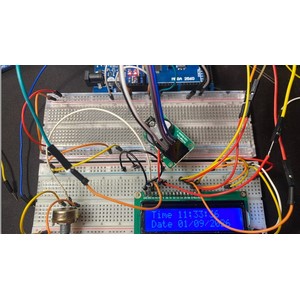
Practical Electronics with Arduino. This course is a comprehensive, hands-on program that helps learners learn the fundamentals of electronics and programming through building real-world projects with the Arduino board, from beginner to advanced. This course is designed as a complete, project-based guide to building real-world, practical systems for those who shy away from complex electronics theory. In this course, learning happens as you build the hardware, starting with a simple LED circuit and progressing to buttons, sensors, displays, motors, buzzers, RFID modules, and keypads. The main board used in this course is the Arduino Mega 2560, and learners learn how to connect various components to the breadboard, understand circuit schematics, write Arduino code, and troubleshoot electronic circuits step by step to ultimately create more advanced electronic systems.
What you will learn
- Build 20 practical Arduino projects including flashing lights, sensor-based alarms, digital displays, and door-model locks
- Reading circuit diagrams and schematics and connecting components such as LEDs, resistors, switches, sensors, displays, and motors to Arduino
- Write and analyze Arduino code using variables, conditions, loops, functions, arrays, and specialized libraries.
- Use digital inputs, analog readings, and PWM to respond to buttons and control LED brightness
- Measuring distance, temperature and humidity and detecting motion, sound and water using advanced electronic sensors
- Controlling servo and stepper motors using potentiometers, joysticks, and data received from sensors
- Display values, numbers, graphics, and time using LCDs, seven-segment displays, and LED matrices
- Building model access control systems using RFID tags, keypad codes, and servo motors
- Troubleshoot wiring and coding problems using compiler messages, serial monitor, and systematic checks
- Modify project codes to adjust timing, sensor thresholds, display patterns, and motor movement
This course is suitable for people who:
- Students who want to gain practical experience in connecting circuits and programming electronic devices.
- Enthusiasts and makers interested in building sensor alarms, digital displays, and motor controllers
- Learners who have tried Arduino code examples and want to deeply understand how the codes work and how to modify them.
- Teachers and STEM club leaders looking for hands-on Arduino projects to use with their learners
Practical Electronics with Arduino course details
- Publisher: Udemy
- Instructor: Simon Angatia
- Training level: Beginner to advanced
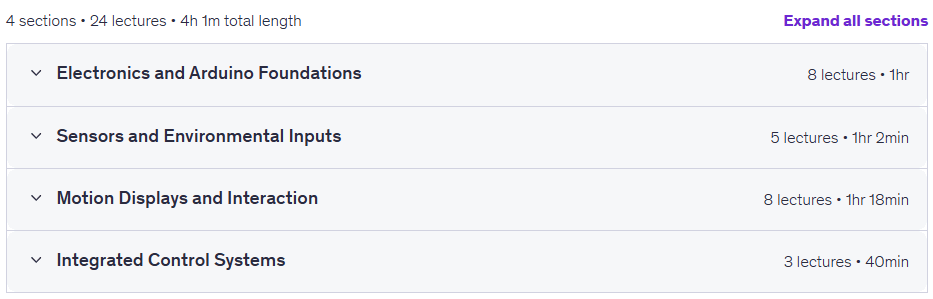
- Training duration: 4 hours and 1 minute
- Number of lessons: 24
Course topics
Prerequisites for the Practical Electronics with Arduino course
- No previous Arduino or programming experience is required. The course starts with simple circuits and builds towards more advanced projects.
- A computer with a USB port and internet access to download the free Arduino IDE and required libraries.
- An Arduino with a compatible USB data cable, a breadboard, and jumper wires. (Mega 2560 is the arduino used in this course)
- Electronic components for the projects, including LEDs, resistors, buttons, sensors, displays, and motors. Each project guide lists what you need.
- Basic computer skills, such as installing software, downloading files, and opening folders.
- A willingness to build circuits, experiment with code, and troubleshoot as you learn.
Course images

Sample course video
Installation Guide
After Extract, view with your favorite player.
Subtitles: None
Quality: 1080p
Download link
Rapidgator link
File(s) password: www.downloadly.ir
File size
5.2 GB