


Description
“Cracking System Design – Distributed Systems Interviews” is a course published by Udemy that focuses on the architectural reasoning skills required for high-level system design and distributed systems interviews. Rather than relying on memorized architectures or isolated definitions, the course teaches a repeatable five-step framework—covering how to understand the interviewer’s goal, clarify requirements, identify constraints and bottlenecks, design the architecture, articulate trade-offs, and handle follow-up questions—and approaches system design interviews as a structured reasoning exercise rather than a test of rote knowledge. Learners begin by understanding the interviewer’s objective, recognizing that most system design questions are intentionally vague, and that a candidate’s primary task is to discern exactly what the interviewer aims to evaluate. The course then teaches learners how to properly clarify requirements and ask targeted questions that narrow an open-ended prompt into a specific, solvable problem, avoiding the pitfalls of guessing the scope.
The core of the course focuses on the early identification of constraints and bottlenecks, teaching learners to reason about scalability, state management, latency, throughput, availability, reliability, and consistency using clear, explainable logic—moving beyond merely citing buzzwords. This section equips learners with the vocabulary and reasoning patterns needed to discuss these trade-offs in the same manner that experienced engineers do during actual design conversations. Building on this foundation, learners practice architectural design step-by-step, employing a five-stage framework to move systematically from requirements to a defensible design—rather than jumping straight to a memorized diagram. The course also emphasizes clearly articulating trade-offs, as interviewers value a candidate’s reasoning process just as much as the final architecture itself. Finally, the course prepares learners to handle follow-up questions and stress-testing by interviewers, applying this same repeatable framework to MAANG-style system design and distributed systems interview questions. By the end of the course, learners will be able to break down interview prompts into the constraints, bottlenecks, trade-offs, and architectural decisions that interviewers truly care about.
What you will learn in Cracking System Design – Distributed Systems Interviews:
- Use a repeatable five-step framework to answer MAANG-style system design and distributed systems interview questions
- Break interview prompts into constraints, bottlenecks, trade-offs, and architecture decisions that interviewers actually care about
- Explain scalability, state management, latency, throughput, availability, reliability, and consistency with clear reasoning
- and …
Course specifications
Publisher: Udemy
Instructors: The Systemic Stack
Language: English
Level: Introductory to Advanced
Number of Lessons: 175
Duration: 15h 3m
Course topics on 2026/8
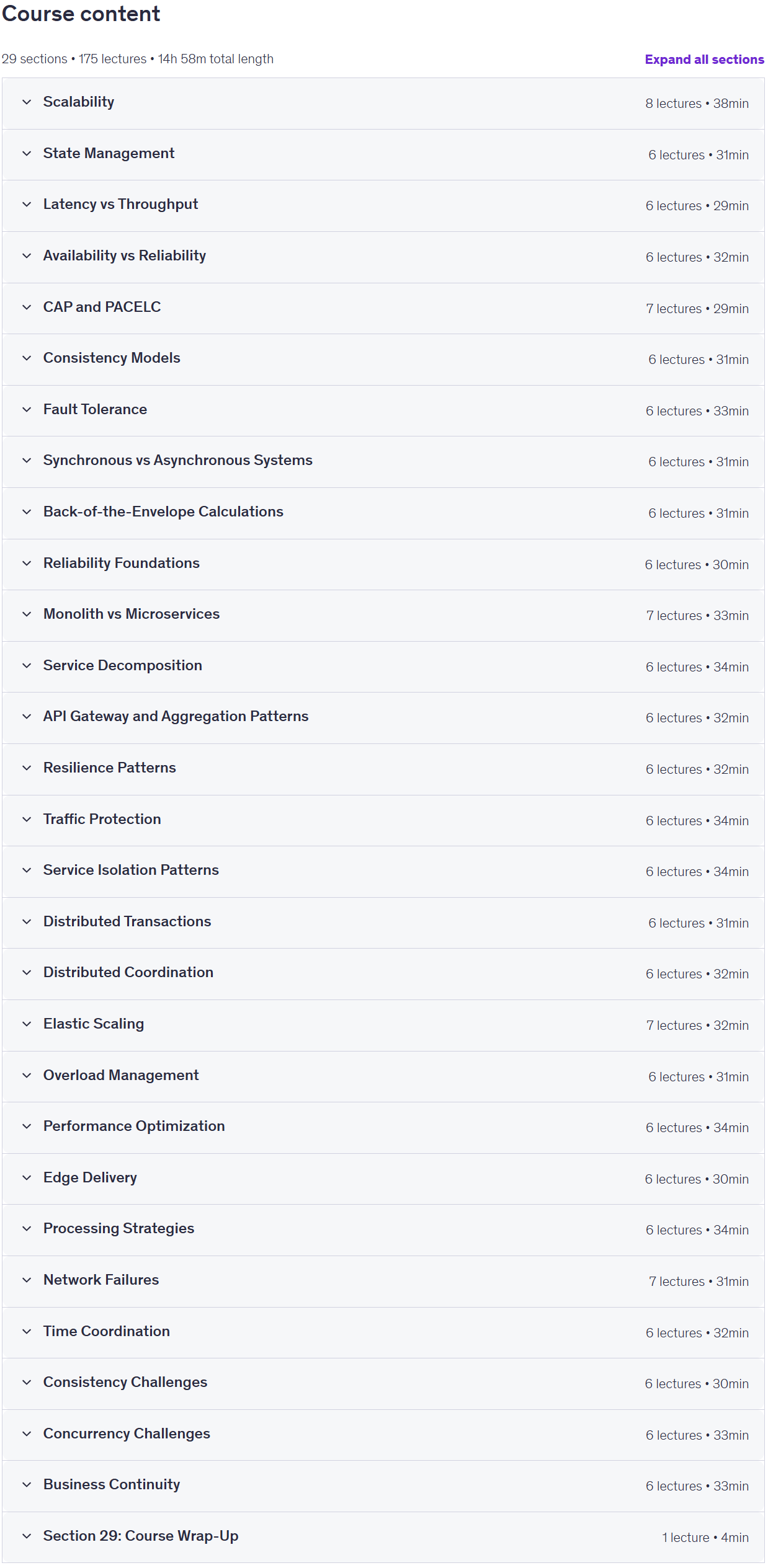
Cracking System Design – Distributed Systems Interviews Prerequisites
Basic programming and software engineering experience
Familiarity with APIs, databases, services, and backend system concepts
Comfort discussing architecture at a high level, even if you are still building interview confidence
Pictures
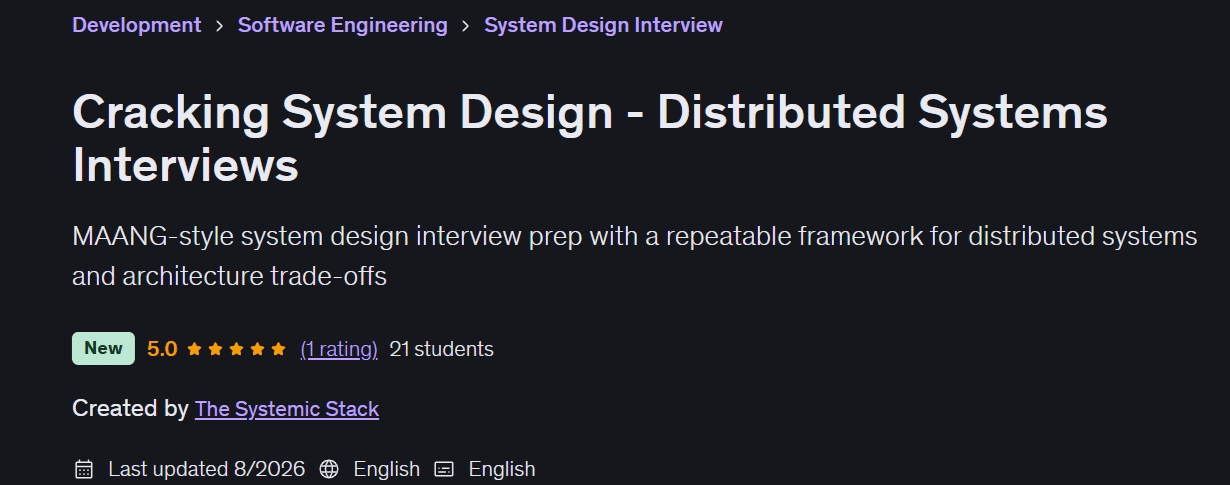
Cracking System Design – Distributed Systems Interviews introduction video
Installation guide
After Extract, watch with your favorite Player.
Subtitle: None
Quality: 1080p
Downloadly link
Rapidgator link
File password (s): www.downloadly.ir
Size
14.5 GB