
Descriptions
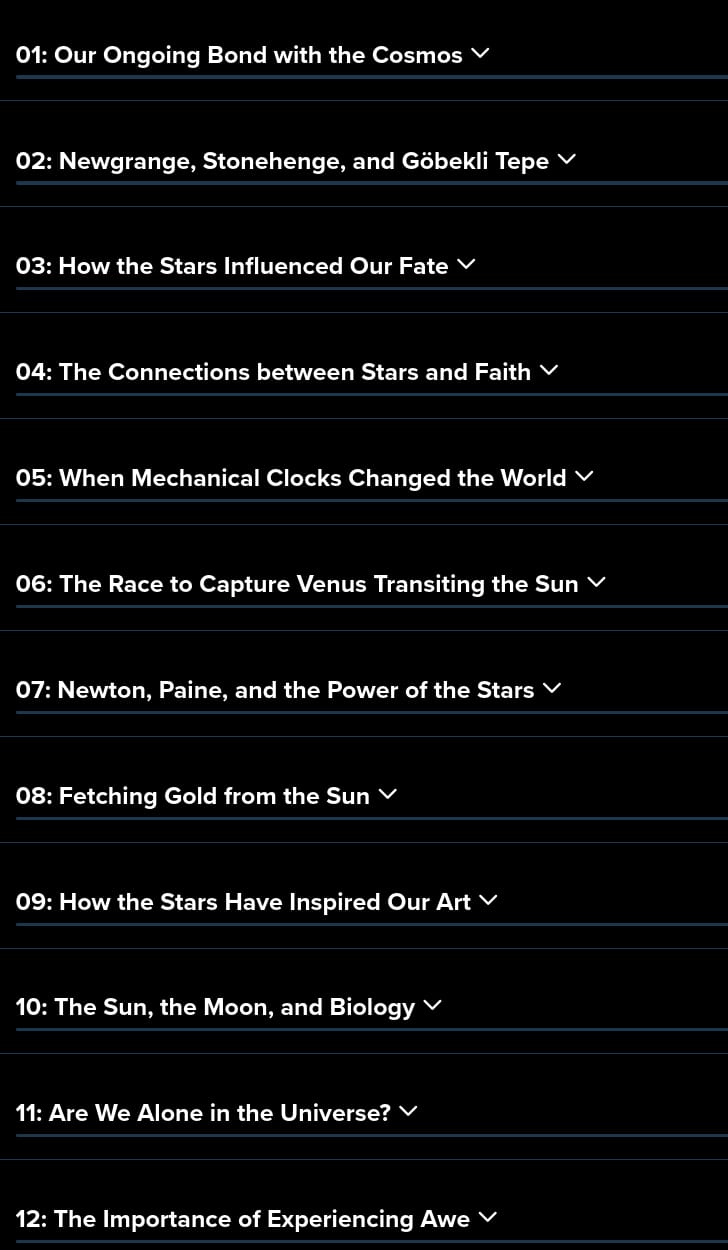
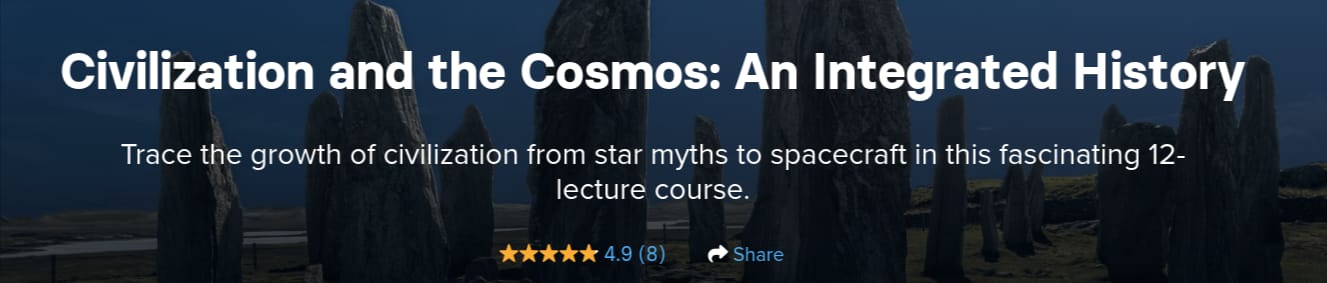
Civilization and the Cosmos: An Integrated History, The night sky may seem far removed from humanity’s long struggle to build civilization, yet the heavens have played a vital role in that story. From prehistoric hunters who imagined myths in the stars to early farmers who used celestial patterns to mark the seasons, navigators who charted voyages, and scientists who transformed our understanding of the universe, people have continually looked upward for meaning, order, and inspiration. In this 12-lecture course, award-winning science journalist and author Dr. Jo Marchant explores the evolving relationship between human civilization and the cosmos, tracing its development from prehistoric skywatching and ancient mythology to written astronomical records, sacred monuments, mechanical clocks, telescopes, spectroscopy, and the search for life beyond Earth.
Going beyond a conventional history of science, the course examines how the heavens influenced art, philosophy, religion, and political thought. Discover how observing the sky encouraged the development of mathematics, contributed to the emergence of physics, shaped sacred calendars, and inspired Enlightenment ideas about rational government. Explore the connections between celestial phenomena and human life, including the ways sunlight, seasonal changes, lunar cycles, and Earth’s magnetic field influence biological processes such as sleep rhythms, fertility, and animal migration. From ancient monuments and the navigation traditions of Polynesia to modern astronomy, distant galaxies, and the possibility of life beyond Earth, this course reveals how the cosmos has shaped human understanding and creativity. Although we may no longer depend on the sky for timekeeping, navigation, agriculture, or religious rituals, it continues to inspire awe, curiosity, humility, and a sense of belonging in a vast and mysterious universe.
What you’ll learn
- Explore how prehistoric people observed the night sky and developed myths and stories around celestial patterns.
- Examine the astronomical and religious significance of ancient monuments such as Newgrange, Stonehenge, and Göbekli Tepe.
- Understand how the development of writing in Mesopotamia transformed the recording and prediction of celestial phenomena, including eclipses and planetary movements.
- Investigate how Judaism, Christianity, and Islam influenced humanity’s understanding of the heavens and incorporated celestial symbolism into religious traditions.
- Trace the development of astronomical instruments and timekeeping, from the Antikythera mechanism to medieval mechanical clocks.
- Compare European and Polynesian navigation traditions and explore how different cultures used stars and other natural signs to navigate.
- Discover how Newtonian science and Enlightenment ideas about the universe influenced political thought and the development of rational government.
- Learn how telescopes and spectroscopy revealed the nature, composition, and properties of the Sun, stars, planets, and galaxies.
- Explore the relationship between astronomy, art, mathematical perspective, relativity, and quantum theory.
- Examine how sunlight, seasonal changes, lunar cycles, and Earth’s magnetic field influence biological processes and living organisms.
- Investigate the scientific search for extraterrestrial life through discoveries of planets around other stars and research into life’s ability to survive in extreme environments.
- Reflect on how the cosmos continues to inspire awe, curiosity, humility, and a sense of connection with the universe.
Who this course is for
- Anyone interested in the history of human civilization and its relationship with the cosmos.
- Learners curious about astronomy, the night sky, stars, planets, and the evolution of humanity’s understanding of the universe.
- People interested in ancient cultures, prehistoric monuments, mythology, and the origins of astronomical observation.
- Students of history, science, philosophy, religion, and the history of ideas who want to explore connections between these fields.
- Those interested in the influence of celestial phenomena on navigation, timekeeping, agriculture, art, and religious traditions.
- Readers and learners curious about modern astronomy, spectroscopy, the search for extraterrestrial life, and the possibility of other civilizations in the universe.
- Anyone seeking a broad, interdisciplinary perspective on how the cosmos has shaped human creativity, knowledge, and culture.
Specificatoin of Civilization and the Cosmos: An Integrated History
- Publisher : The Great Courses
- Teacher : Jo Marchant
- Language : English
- Level : All Levels
- Number of Course : 12
- Duration : 6 hours and 32 minutes
Content of Civilization and the Cosmos: An Integrated History
Pictures
Sample Clip
Installation Guide
Extract the files and watch with your favorite player
Subtitle : Not Available
Quality: 720p
Download Links
Password file(s): www.downloadly.ir
File size
5.55 GB