


Description
“Recursive Language Models and Advanced LLM Architectures” is a course published by Udemy that explores the principles behind modern Large Language Models (LLMs). Designed for machine learning engineers, AI researchers, and developers interested in advanced generative AI, this course offers valuable insights into emerging language model architectures. You will examine Transformer-based architectures, attention mechanisms, context processing, and recursive computations, learning how various architectural strategies impact reasoning, efficiency, and model performance. The course explains three interpretations of “recursive” in deep learning: tree-based networks, recurrent depth, and Recursive Language Models (RLMs). You will build a small decoder-only Transformer from scratch to serve as a benchmark for other architectures. You will implement recursive networks, Tree-LSTMs, and weight-shared recurrent Transformers, comparing them under equal parameter constraints. Additionally, you will manually execute a recursive language model loop using a Python REPL and a local model, tracing the process step-by-step.
You will incorporate sliding-window and linear attention mechanisms into the baseline model, evaluating memory usage, speed, and quality relative to sequence length. You will implement a selective state-space layer, train a small Mamba-style model, and compare a pre-trained Mamba model against Pythia on a CPU. Finally, you will construct Mixture-of-Experts (MoE) layers, observe expert load distribution with and without load balancing, and examine the mechanics of an actual MoE router. You will measure KV cache usage, manage it using Transformers cache classes, and stabilize text generation with attention sinks. You will build and evaluate a production-ready RAG pipeline incorporating chunking, FAISS, hybrid search, re-ranking, and content integrity checks. Finally, you will conduct fair architectural comparisons and produce an architecture selection report supported by a comprehensive results table. The course introduces advanced concepts in model design, information processing, task decomposition, and interaction with external tools or resources; it provides a deeper understanding of the trade-offs involved in inference optimization, context management, tool integration, and balancing computational cost, scalability, accuracy, and reasoning capabilities in modern AI systems.
What you will learn in Recursive Language Models and Advanced LLM Architectures:
- Explain the three meanings of recursive in deep learning: tree networks, looped depth and Recursive Language Models
- Build a small decoder-only transformer from scratch and use it as a measured baseline for every other architecture
- Implement recursive networks, Tree-LSTM and a weight-tied looped transformer, and compare them at equal parameters
- Build a Recursive Language Model loop by hand with a Python REPL and a local model, and read every step of its trace
- Add sliding-window and linear attention to the baseline and measure memory, speed and quality against sequence length
- Implement a selective state space layer, train a tiny Mamba-style model and compare pretrained Mamba with Pythia on CPU
- Build mixture-of-experts layers, watch expert load with and without balancing, and inspect a real MoE router
- Measure the KV cache, manage it with the transformers cache classes and keep generation stable with attention sinks
- Build and evaluate a production-style RAG pipeline with chunking, FAISS, hybrid search, re-ranking and faithfulness checks
- Run fair architecture comparisons and write an architecture selection report backed by a complete results table
- and …
Course specifications
Publisher: Udemy
Instructors: NEXUS ACADEMY
Language: English
Level: Introductory to Advanced
Number of Lessons: 115
Duration: 11 hours and 12 minutes
Course topics
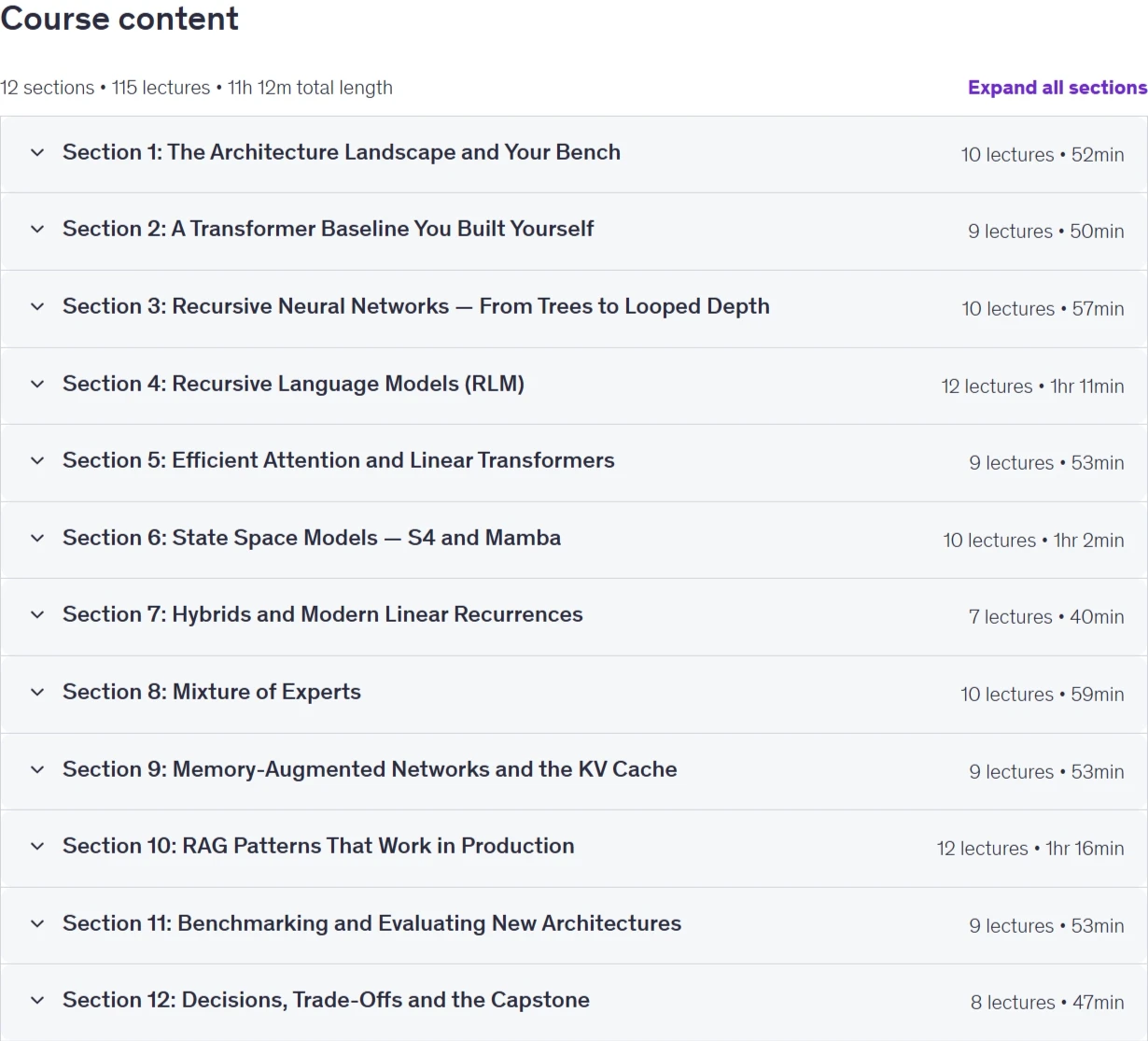
Recursive Language Models and Advanced LLM Architectures Prerequisites
Working Python and basic PyTorch: you can read a training loop and run a script from the command line
A computer with a multi-core CPU. No GPU is needed: the course bench is an 8-CPU machine and every lab is measured on it
Pictures
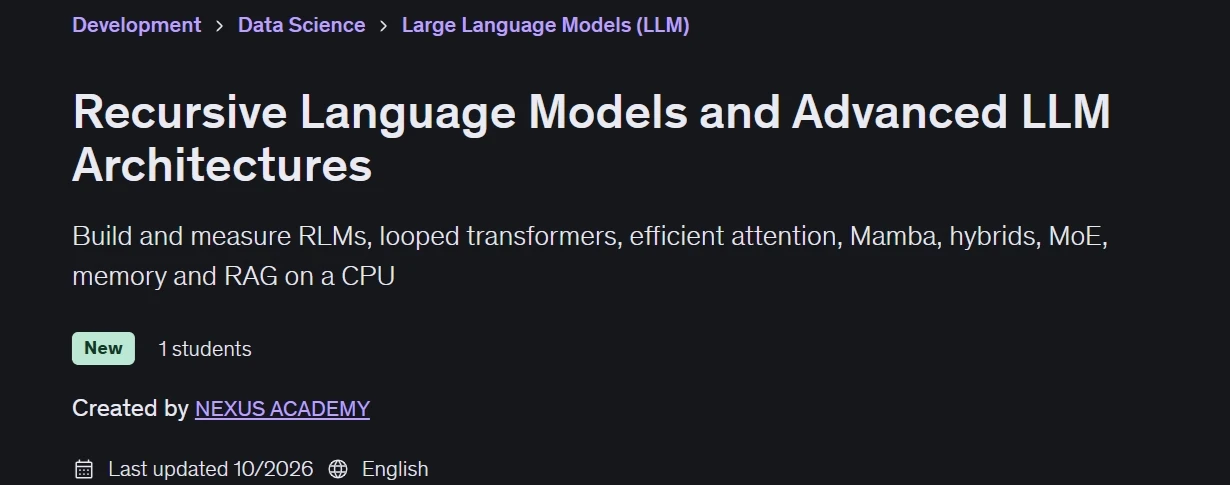
Recursive Language Models and Advanced LLM Architectures introduction video
Installation guide
After Extract, watch with your favorite Player.
Subtitle: None
Quality: 1080p
Downloadly link
Rapidgator link
File password (s): www.downloadly.ir
Size
2 GB