


Description
Spring Boot Microservices: Banking & Payment System Design is a course on how to design and build scalable microservices using Spring Boot through real-world banking and payment system scenarios, published by Udemy Online Academy. Designed for Java developers, backend engineers, and aspiring microservice architects, this course explores how to design, develop, secure, communicate, test, and deploy distributed services in production environments. Students will learn about Spring Boot, Spring Cloud, REST APIs, service discovery, API gateways, inter-service communication, database management, authentication and authorization, transaction management, messaging, fault tolerance, and distributed system design.
This is not a comprehensive tutorial where every line of code is explained in detail. Many of the implementation details are intentionally discussed at the architectural level, as the goal is to understand system design decisions rather than individual framework features. If you are still learning the basics of Spring Boot, you will probably find parts of this course challenging and may find it difficult to follow. The goal is not to teach you Spring Boot from scratch. The goal is to teach you how experienced engineers design, build, and deploy production-level banking systems. By the end of this course, you will have a good understanding of how to design and build scalable microservices using Spring Boot and real-world banking and payment system scenarios.
What you will learn in Spring Boot Microservices: Banking & Payment System Design:
- Design a real-world digital banking system using microservices, applying domain-driven design principles to split core banking domains
- Build production-ready backend services using Spring Boot, including REST APIs, validation, persistence with Spring Data JPA, and secure service boundaries.
- Implement event-driven workflows using Kafka, enabling asynchronous communication, sagas, retries, and loosely coupled services for real payment flows.
- Model secure authentication and authorization flows using JWT and Auth0, covering both user-initiated requests and service-to-service communication.
- Design and implement payment orchestration patterns, including holds, postings, idempotency, and failure handling across distributed systems.
- Apply real banking principles such as ledger-based transaction history, auditability, and separation of balance and transaction concerns.
- and …
Course specifications
Publisher: Udemy
Instructors: Raman Singh
Language: English
Level: Introductory to Advanced
Number of Lessons: 52
Duration: 6h 33m
Course topics
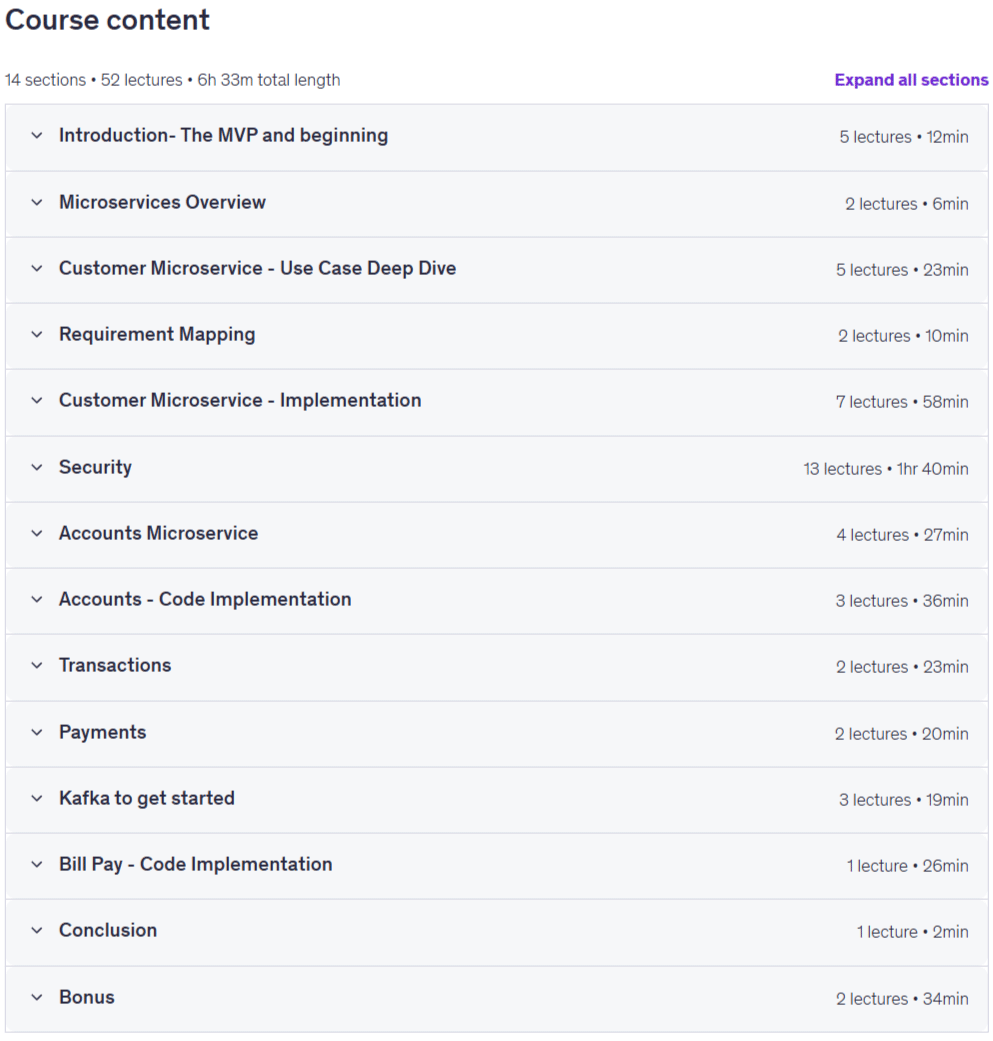
Spring Boot Microservices: Banking & Payment System Design Prerequisites
Good experience with Java and Spring Boot, including familiarity with REST APIs and common backend concepts.
Understanding of fundamental software engineering concepts, such as HTTP, JSON, databases, and basic object-oriented design.
Good exposure to backend development and microservices concepts is needed
Willingness to learn production-grade system design, rather than expecting a beginner-level or theory-only course.
Pictures
Spring Boot Microservices: Banking & Payment System Design introduction video
Installation guide
After Extract, watch with your favorite Player.
Subtitle: None
Quality: 1080p
Downloadly link
Rapidgator link
File password (s): www.downloadly.ir
Size
4.3 GB