


Description
PostgreSQL for AI: Master SQL, pgvector, RAG & Vector Search. This course explores how to use PostgreSQL and the pgvector extension to build AI infrastructures, vector search, and RAG architectures. PostgreSQL is the engine that powers modern AI applications. All applications based on large language models (LLMs) require a fast and reliable backend to store, filter, and search multidimensional embeddings. While many developers are turning to discrete and complex vector databases, technology leaders are turning to the most trusted relational database, PostgreSQL. This course provides a comprehensive roadmap for building operational-quality AI infrastructures using PostgreSQL and the pgvector extension. This course bridges the gap between traditional relational database management systems (RDBMSs) and modern AI infrastructures. This course is designed to be completely project-based, and learners will experience real-world coding throughout 20 practical chapters. The course covers concepts such as installing and optimizing the pgvector plugin, calculating cosine and L2 distances, and implementing HNSW and IVF indexes to speed up searches. It also covers building complete RAG pipelines using Python, LangChain, and LlamaIndex, along with combining traditional SQL and semantic vector search. Security topics such as row-level security (RLS), table partitioning, and managing read echoes for AI infrastructure scalability are also covered in detail, so that learners can design and implement resilient and scalable databases for their operational applications. In addition, the course helps developers automate index maintenance management and database performance optimization under heavy AI workloads. By examining optimized execution plans and using pg_stat_statements, learners learn to identify bottlenecks and improve system performance. This course is a comprehensive solution for organizations that want to manage traditional relational data alongside AI vector data.
What you will learn
- Advanced PostgreSQL administration: Master database administration, data modeling, CTE expressions, and window functions for predictive analytics.
- Implementation of the pgvector plugin: store, set, and query multidimensional machine learning embeddings directly in SQL.
- Building RAG Pipelines: Implementing and deploying operational RAG architectures using Python, LangChain, and LlamaIndex.
- Search engine optimization: Using ANN indexing frameworks such as HNSW and IVF for fast vector matching.
- Hybrid search design: Combine traditional SQL filters with semantic vector search capabilities for accurate data retrieval.
- Data Security: Secure AI data with Row-Level Security policies and data privacy controls.
- Workload Scalability: Manage heavy workloads with table partitioning, read replicators, and cloud deployment techniques.
- Automated troubleshooting and maintenance: Identify performance bottlenecks and automate the processes of cleaning and maintaining vector indexes.
This course is suitable for people who:
- Backend and Software Developers: Programmers who plan to build AI-based applications and the backend of LLM.
- Data Engineers and AI Architects: Professionals responsible for designing and optimizing data pipelines and RAG architectures.
- SQL Developers and Database Administrators: Engineers who want to upgrade their skills and master PostgreSQL AI extensions.
- Full-stack developers and technical leaders: Decision makers who want to use a powerful relational database to manage relational and vector data simultaneously.
PostgreSQL for AI: Master SQL pgvector RAG & Vector Search Course Details
- Publisher: Udemy
- Instructor: Sachin Kumar
- Training level: Beginner to advanced
- Training duration: 8 hours and 21 minutes
- Number of lessons: 43
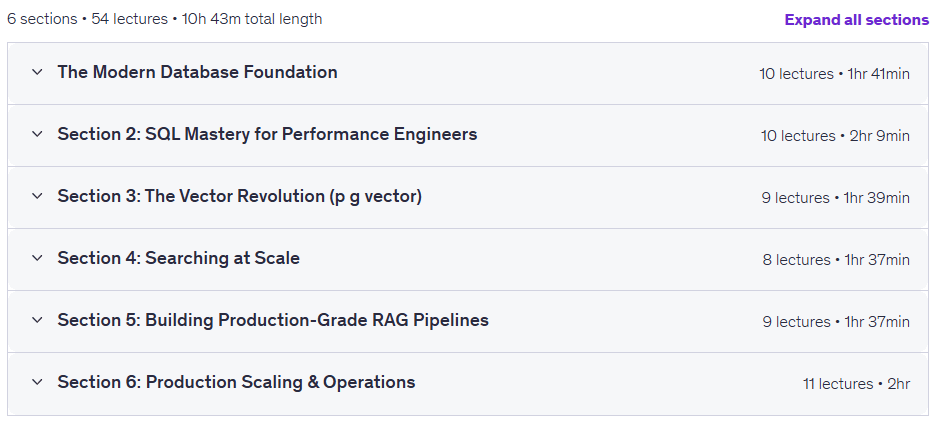
Course syllabus as of 2026/9
PostgreSQL for AI: Master SQL pgvector RAG & Vector Search Course Prerequisites
- Basic SQL Knowledge: Familiarity with writing simple database queries (such as standard SELECT, WHERE, and JOIN statements) is helpful but not mandatory.
- Fundamental Python Skills: A basic understanding of Python syntax will help you comfortably follow along during the hands-on AI integration and LangChain labs.
- No Prior AI or Vector Experience Required: We teach the math and mechanics behind high-dimensional embeddings, pgvector, and HNSW indexes completely from scratch.
- A Computer (Windows, Mac, or Linux): You will need a standard laptop or desktop computer to install Docker or PostgreSQL and build your local development environment.
Course images

Sample course video
Installation Guide
After Extract, view with your favorite player.
Subtitles: None
Quality: 1080p
Download link
Rapidgator link
File(s) password: www.downloadly.ir
File size
7.7 GB