


Descriptions
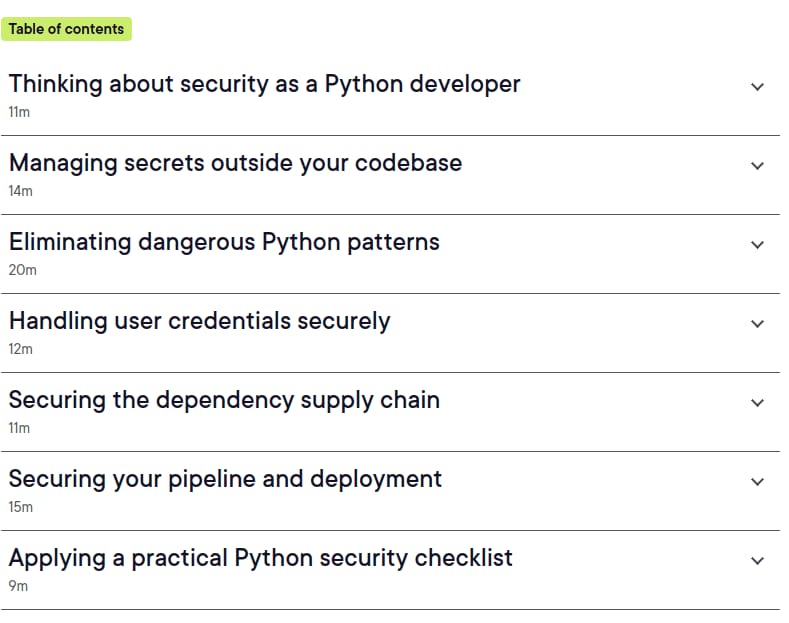
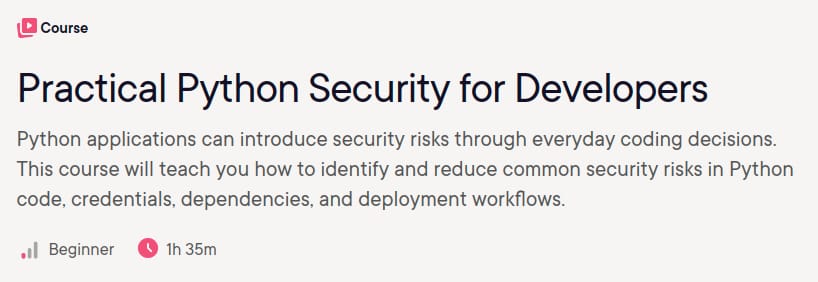
Practical Python Security for Developers, Python applications frequently handle external input, sensitive credentials, third-party dependencies, and deployment configuration, making secure development practices essential. In this course, Practical Python Security for Developers, you’ll learn to identify and reduce common security risks in Python applications. You’ll explore Python security fundamentals and dangerous coding patterns that can lead to injection vulnerabilities, unintended code execution, and information exposure. You’ll also learn to identify trust boundaries in your code and apply defense-in-depth principles to improve application security.
Next, you’ll discover how to manage secrets and credentials securely, including using environment configuration, managed secret stores, least privilege, and credential rotation. You’ll learn to prevent command injection, SQL and ORM injection, unsafe data and file handling, and insecure password storage; generate secure tokens; and implement authentication and authorization checks. Finally, you’ll explore dependency supply-chain security, identify and fix vulnerable packages with tools such as pip-audit, add security checks to CI/CD pipelines and GitHub Actions, protect pipeline credentials, harden Python applications for production, and apply a practical security checklist to prioritize findings and verify fixes.
What you’ll learn
- Explain Python security fundamentals, identify trust boundaries, and apply defense-in-depth principles.
- Recognize dangerous coding patterns that can cause injection vulnerabilities, unintended code execution, and information exposure.
- Manage secrets and credentials securely using environment configuration, managed secret stores, least privilege, and rotation.
- Prevent command injection, SQL and ORM injection, and unsafe data and file handling.
- Store passwords securely, generate secure tokens, and implement authentication and authorization checks.
- Assess third-party dependencies, identify vulnerable packages with tools such as pip-audit, and reduce supply-chain risks.
- Add security checks to CI/CD pipelines and GitHub Actions, protect pipeline credentials, harden Python applications for production, and verify fixes with a practical security checklist.
Who this course is for
- Python developers who want to identify and reduce security risks in their applications.
- Software developers who handle external input, credentials, files, and sensitive information in Python projects.
- Developers responsible for third-party dependencies, CI/CD pipelines, and application deployment.
- Developers who want practical methods and checklists for reviewing, hardening, and verifying the security of Python applications.
Specificatoin of Practical Python Security for Developers
- Publisher : Pluralsight
- Teacher : Tejprakash Kumawat
- Language : English
- Level : All Levels
- Duration : 1 hours and 36 minutes
Content of Practical Python Security for Developers
Pictures
Sample Clip
Installation Guide
Extract the files and watch with your favorite player
Subtitle : English
Quality: 1080p
Download Links
Password file(s): www.downloadly.ir
File size
237 MB