


Descriptions
Microeconomics Made Clear, From farmers markets to corporate boardrooms, and from political debates over taxes and tariffs to disputes between labor and capital, microeconomics is part of everyday life. Every day, people make choices under conditions of scarcity, deciding how to spend time and money, while businesses determine what to produce and governments decide how to tax, subsidize, or regulate. Through the interaction of millions of these decisions, markets allocate resources, create prosperity, generate inequality, and sometimes fail. Taught by Dr. Akila Weerapana of Wellesley College, this course presents 24 insightful lectures that explain how microeconomics works through accessible charts and models, beginning with scarcity and purposeful decision-making and introducing opportunity costs, production possibilities frontiers, marginal analysis, trade, consumer preferences, demand, supply, market equilibrium, elasticity, and the efficiency of markets.
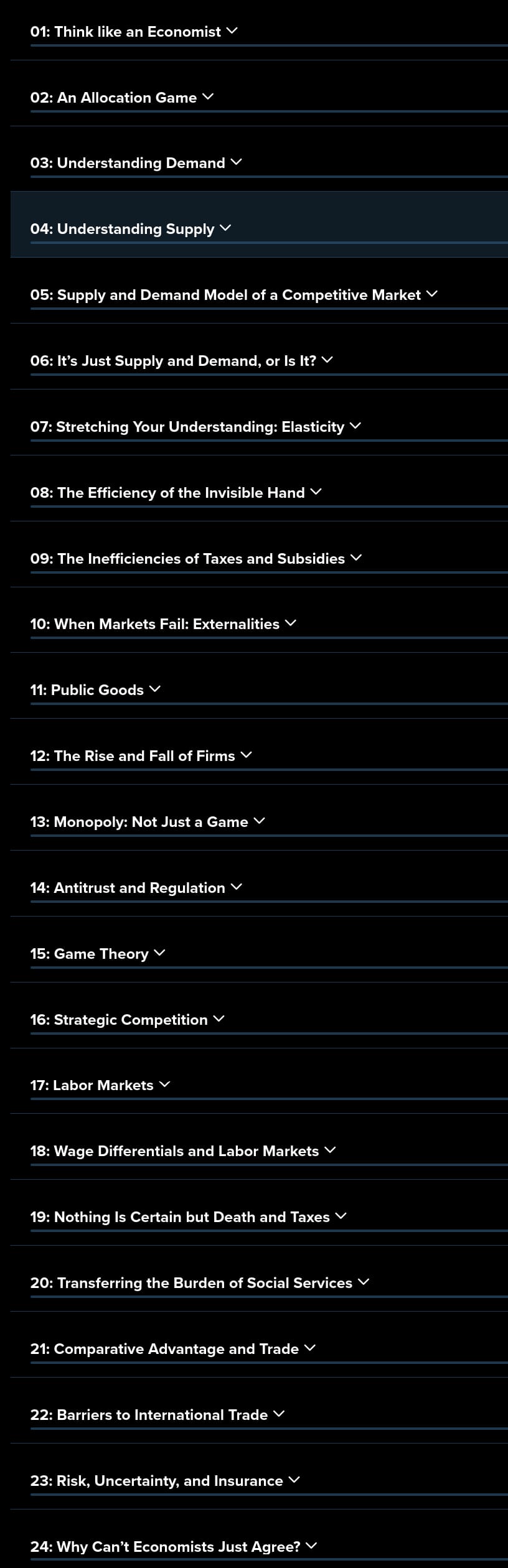
The course develops a practical toolkit for understanding market behavior and economic policy. Explore the invisible hand, taxes and subsidies, externalities, public goods, firms and production costs, monopoly, antitrust enforcement, regulation, game theory, strategic competition, labor markets, wage differences, taxation, government transfer programs, comparative advantage, international trade barriers, risk, uncertainty, and insurance. Through examples ranging from consumer purchases and business decisions to tariffs, employment, and government policy, you will examine how markets operate, why they sometimes fail, and how economic concepts can help explain real-world outcomes. The final lecture considers developments in microeconomics, including the credibility revolution and behavioral insights, and how economists use these concepts to investigate important economic questions.
What you’ll learn
- Understand scarcity, purposeful decision-making, opportunity costs, production possibilities frontiers, and marginal analysis.
- Explain trade, economic surplus, efficiency, and how markets allocate resources.
- Analyze consumer preferences, utility, demand curves, consumer surplus, and budget constraints.
- Understand supply, marginal costs, producer surplus, market equilibrium, and the causes of surpluses and shortages.
- Explain market shocks and elasticity, including how changes in supply, demand, and prices affect market outcomes.
- Evaluate market efficiency and the effects of taxes, subsidies, externalities, public goods, and government intervention.
- Analyze firms, production costs, economies of scale, mergers, monopoly power, antitrust policies, and regulation.
- Apply game theory and strategic decision-making concepts to oligopolies, cooperation, collusion, and competition.
- Understand labor supply and demand, wage determination, wage differences, discrimination, human capital, minimum wages, and unions.
- Examine taxation, government transfer programs, comparative advantage, international trade restrictions, risk, uncertainty, insurance, and asymmetric information.
Who this course is for
- Students and learners interested in understanding the principles of microeconomics.
- Individuals seeking to understand how consumer and business decisions influence market outcomes.
- Business professionals interested in market behavior, competition, production costs, and strategic decisions.
- Readers interested in economic policy, taxation, government regulation, labor markets, and international trade.
Specificatoin of Microeconomics Made Clear
- Publisher : The Great Courses
- Teacher : Akila Weerapana
- Language : English
- Level : All Levels
- Number of Course : 24
- Duration : 12 hours and 45 minutes
Content of Microeconomics Made Clear
Pictures

Sample Clip
Installation Guide
Extract the files and watch with your favorite player
Subtitle : Not Available
Quality: 720p
Download Links
Downloadly
Rapidgator
Password file(s): www.downloadly.ir
File size
10.87 GB
2 Comments. Leave new
please rapaidgator link ?
Hi
Added