


Description
Reverse Engineering & Malware Analysis Course. This course teaches the principles and methods of reverse engineering and malware analysis, from the basics of processor architecture and assembly language to static and dynamic analysis of Windows executables. This course is a complete and practical path to learning how to analyze native programs in the Windows operating system and investigate malware from the very beginning. This course introduces learners to basic concepts such as processor architecture (CPU), registers, virtual memory, machine code, and assembly language, and then teaches methods for examining real executable files and tracking program behavior using professional reverse engineering tools. In this course, the audience learns how programs work at the machine code level, what the structure of Windows executable files is, how analysts examine suspicious files, and how to combine static and dynamic analysis techniques to accurately understand the behavior of a program. In the different sections of this training, first, processor architecture, instruction sets, symbols (Mnemonics), operands (Operands), opcodes (Opcodes), bit operations, byte order (Endianness) and different parts of the program are reviewed. Then, the structure of portable executable (PE) files and how to analyze them in Windows are taught along with practical labs and practical demonstrations. In addition, the course examines Windows API calls, text strings and their role in discovering malware behavior. Learners use tools such as IDA Pro and hexadecimal editors for static analysis to understand the logic and code of the program without running it. Also, for dynamic analysis, how to work with debuggers and the WinDbg tool to view the running program, use breakpoints, check registers, and follow commands line by line is taught to create a strong scientific foundation for entering advanced levels of reverse engineering and malware analysis.
What you will learn
- Reverse Engineering Process and Methodology: Thorough understanding of reverse analysis steps and malware investigation methodologies.
- Fundamentals of CPU Architecture and Assembly Language: Learning CPU architecture concepts, registers, virtual memory and x86/x64 assembly language.
- Machine code and instruction concepts: Understanding instruction set architecture (ISA), opcodes, symbols, operands, and bitwise operations.
- Exploring Windows file structure: analyzing native code and working with the Portable Executable (PE) file format.
- API Call Analysis: Functional analysis and review of Windows API calls and use strings as clues.
- Performing applied static analysis: Using IDA Pro tool and hexadecimal analysis software to examine the structure of binary codes.
- Perform dynamic analysis and debugging: Use the WinDbg tool and debuggers to examine the behavior of a running program and trace instructions.
- Understanding control and calling structures: analyzing functions, stack frames, calling conventions, loops, and arrays.
- Network Analysis: Familiarity with the basics and concepts of network analysis in order to examine the communication behaviors of malware.
- Combining analysis methods: Integrating static and dynamic techniques to gain a comprehensive view of the behavior of suspicious applications.
This course is suitable for people who:
- Beginners: Those who want to start learning reverse engineering from the basics.
- Cybersecurity students and professionals: Individuals looking to develop their technical knowledge in the field of security.
- Security researchers: Researchers who aim to analyze the behavior of various software and malware.
- Software developers: Programmers who want to understand how compiled code works on Windows.
- Penetration testing and incident response experts: professionals who need to analyze malicious code in real-world scenarios.
- Windows architecture enthusiasts: Anyone interested in learning assembly language and the internal structure of Windows.
Reverse Engineering & Malware Analysis Course Details
- Publisher: Udemy
- Lecturer: Danish Qadri PhD
- Training level: Beginner to advanced
- Training duration: 3 hours and 46 minutes
- Number of lessons: 44
Course topics
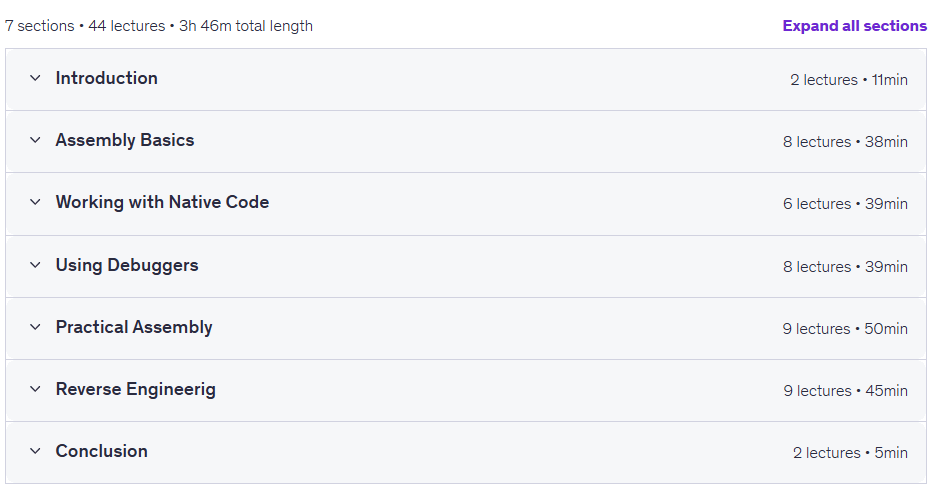
Reverse Engineering & Malware Analysis Course Prerequisites
- Basic understanding of computers and Windows operating systems
Course images
Sample course video
Installation Guide
After Extract, view with your favorite player.
Subtitles: None
Quality: 720p
Download link
Rapidgator link
File(s) password: www.downloadly.ir
File size
1.1 GB