


Description
Large Language Models: From Foundations to Transformers. This course is a comprehensive and foundational path to learning the architecture of large language models, from the basics of deep learning and vector embeddings to self-attention mechanisms, transformer architecture, and LLM scalability. This course is the first step in a three-step Agentic AI Mastery path that introduces learners to the core structure and infrastructure of modern AI. Unlike superficial courses that focus only on calling ready-made APIs, this training program builds your knowledge from the ground up and in a systematic way so that you have sufficient mastery when facing technical challenges or needing to fine-tune models. Learning in this course begins with a review of the basics of artificial intelligence and machine learning and then addresses key deep learning concepts such as neural networks, backpropagation, and activation functions. The course continues with a review of natural language processing (NLP) and the embedding space, and teaches how to convert text to vectors for semantic search. Students will thoroughly analyze the mechanisms of Self-Attention and Positional Encoding by examining sequential models from RNN and LSTM to the Transformers revolution. Finally, the training, fine-tuning, decoding strategies, and scalability of large LLM language models are examined. This course prepares students for entry into advanced LLM engineering and Agentic AI courses by providing hands-on coding labs, deep analysis audio podcasts, architecture diagrams, and a comprehensive ChefBot final project.
What you will learn
- Mastery of the core mechanisms of AI and Deep Learning, from Backpropagation and Activation Functions to Self-Attention and Positional Encodings
- Implementation and evaluation of sequential models and comparison of RNN and LSTM networks with parallel Transformer architecture
- Building dense Vector Embeddings and developing semantic vector search engines using industry standard frameworks such as FAISS
- Complete understanding of the LLM lifecycle including Scaling Laws, Pre-training, Supervised SFT Fine Tuning, and RLHF and DPO Preference Alignment
- Controlling how text is generated in LLM through Decoding parameters including Top-K, Top-P, and Temperature, and examining the mechanism of Open-Weights models to fix errors.
This course is suitable for people who:
- Software engineers and developers who want to switch from regular application development to AI engineering and LLM
- Data Scientists and Machine Learning beginners who want to move from traditional scikit-learn pipelines to modern Transformer architectures
- Computer science students and technology professionals who are looking for a deep, fundamental understanding of how LLMs work internally and don’t want to just use off-the-shelf APIs
Course details: Large Language Models: From Foundations to Transformers
- Publisher: Udemy
- Instructor: Dr. Ryan Rad
- Training level: Beginner to advanced
- Training duration: 6 hours and 57 minutes
Course syllabus in 2026/7
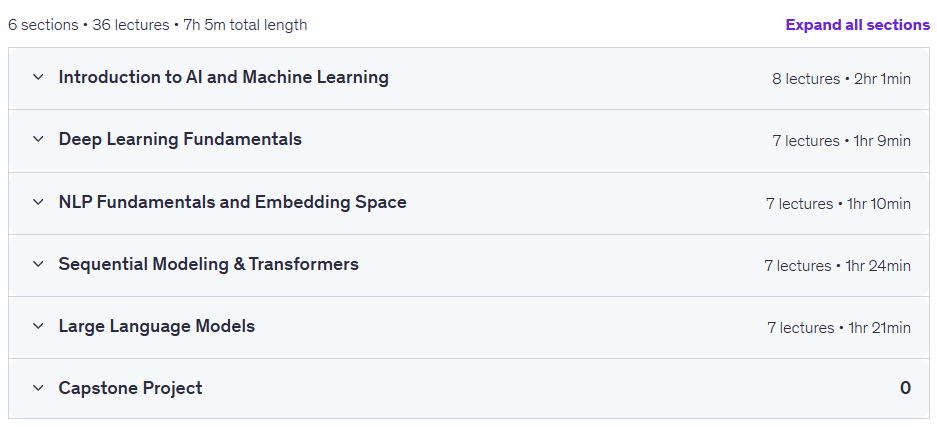
Prerequisites for the course Large Language Models: From Foundations to Transformers
- Intermediate Python: Familiarity with functions, loops, and basic data structures (code is explained step-by-step, but you should be comfortable reading Python).
- High-School / Basic College Math: Basic familiarity with vectors, matrices, and simple calculus concepts (all key mathematical concepts are refreshed intuitively throughout the course).
- No prior AI/Deep Learning experience required! We build everything from absolute ground zero.
Course images
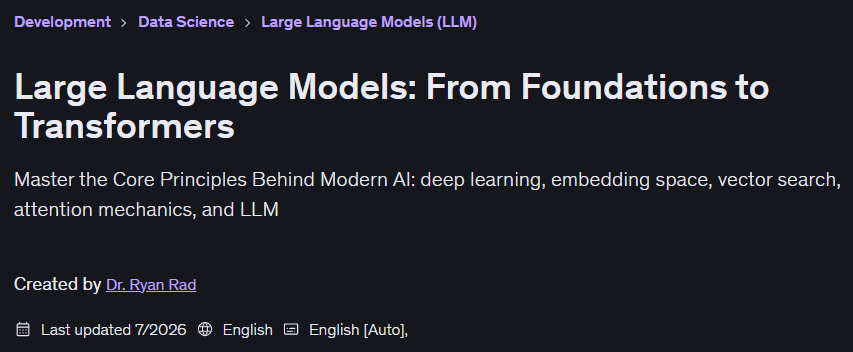
Sample course video
Installation Guide
After Extract, view with your favorite player.
Subtitles: None
Quality: 1080p
Download link
Rapidgator link
File(s) password: www.downloadly.ir
File size
5.3 GB