


Description
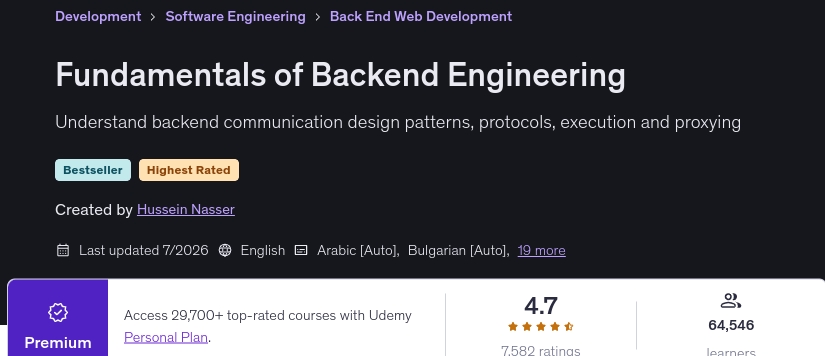
Fundamentals of Backend Engineering published by Udemy Academy. Understand backend communication design patterns, protocols, implementations and proxies.
Backend engineering is an art. During my 18-year career working with and building back-end applications, I’ve noticed certain communication design patterns emerging. There are a handful of ways that clients interact with backend applications, although there may be more, I believe the patterns I discuss in this course are the most common. Examples of these patterns are request-response, publish-subscribe, short and long, and push. Based on these communication design patterns, engineers may use a number of protocols for concrete communication. While the main transport vehicles are limited to either TCP or UDP, thousands of industry-specific protocols have been built on top of these two to address specific problems and use cases. Examples of these high-level protocols include: HTTP/1.1, HTTP/2, HTTP/3, gRPC, WebRTC, and many others. Other transport protocols such as QUIC are built on top of UDP to lower HTTP/2 traffic at the transport level. Each protocol has its advantages and disadvantages and is tailored to specific use cases. In this course, I will discuss the most common protocols and provide examples and demos where appropriate.
What you will learn in the Fundamentals of Backend Engineering course:
- Learn the basics of backend engineering
- Backend communication design patterns
- Understand how backend communication protocols work.
- Understand how the operating system core interacts with backend applications.
- Fundamentals of the operating system (Thread, Process, async IO in Linux)
- Learn HTTP/1.1, HTTP/2, HTTP/3.
- And …
Who is this course suitable for:
- Backend engineers
- Full stack engineers
- Frontend engineers interested in Backend (must have built a Backend application)
- Network engineers who want to get better at backend design.
- Site Reliability Engineers
Course specifications
- Publisher : Udemy
- Teacher : Hussein Nasser
- Language: English
- Level : All Levels
- Lectures : 64
- Duration : 20 hours and 2 minutes
Course topics

Course prerequisites
Intermediate programming skills (1-2 years)
Having built a backend application
Basic network fundamentals
Pictures
Fundamentals of Backend Engineering introduction video
Installation guide
After Extract, watch with your favorite Player.
Subtitle: English
Quality: 1080p
Previous title:
Fundamentals of Backend Communications and Protocols
Changes:
The 2024/10 version has increased the number of lessons by 2 and the duration by 10 minutes compared to 2024/5.
The 2025/5 version has increased the number of lessons by 4 and the duration increased by 1 hours 47 minutes compared to 2024/10.
The 2025/10 version has increased the number of lessons by 1 and the duration increased by 28 minutes compared to 2025/5.
The 2026/7 version has increased the number of lessons by 1 and the duration increased by 25 minutes compared to 2025/10.
The new version 2026/7 has not changed in the number of lessons and duration compared to the previous version 2026/7, but the quality of the course has increased from 720p to 1080p.
Download link
password file(s): www.downloadly.ir
File Size
19.4 GB
1 Comment.
Okay, you have made my career, thank you 😀