
Descriptions
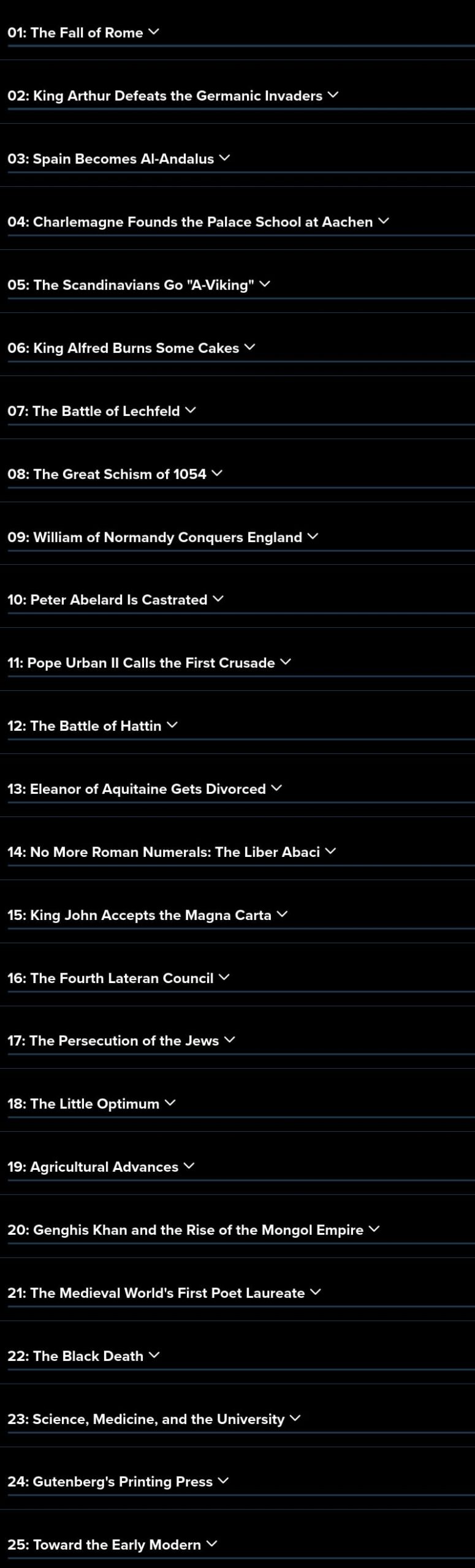
Turning Points in Medieval History, 2nd Edition, The medieval era, spanning roughly 500 to 1500 CE, was a transformative period in Western history. In this course, Professor Dorsey Armstrong of Purdue University guides you through 25 lectures exploring the pivotal events, people, conflicts, and developments that shaped the Middle Ages and influenced the evolution of Western civilization. Examine major turning points such as the fall of Rome, the rise of Al-Andalus, Charlemagne’s educational legacy, Viking expansion, the Battle of Lechfeld, the Great Schism, the Norman conquest of England, and the First Crusade. Discover how the decisions and actions of influential figures, including Eleanor of Aquitaine, King John, Peter Abelard, and Genghis Khan, reshaped political, religious, military, and intellectual life.
Explore the far-reaching effects of the medieval warm period, agricultural innovations, the growth of trade and cities, the Black Death, and the development of medicine and universities. The course also examines the spread of Hindu-Arabic numerals, the Magna Carta, the Fourth Lateran Council, the persecution of Jewish communities, the emergence of humanism through Petrarch, and Gutenberg’s printing press. From changing systems of warfare and government to transformations in education, religion, economics, and culture, these 25 lectures reveal how decisive moments and gradual developments shaped medieval society and helped lay the foundations of the early modern world.
What you’ll learn
- Understand the major turning points that shaped Western civilization during the medieval era, from approximately 500 to 1500 CE.
- Examine the fall of the Roman Empire and its influence on the societies that emerged in the Middle Ages.
- Analyze the political, military, and social consequences of events such as the Battle of Lechfeld, the Norman conquest of England, and the Crusades.
- Explore the influence of important historical figures, including Charlemagne, Eleanor of Aquitaine, Peter Abelard, and Genghis Khan.
- Understand the development of medieval religious institutions, including the Great Schism, the Fourth Lateran Council, and changing relations between Christianity and Islam.
- Investigate how climate change, agricultural innovations, trade, and urbanization transformed medieval European society.
- Examine the social and economic consequences of the Black Death and the development of medicine and universities.
- Recognize the contributions of developments such as Hindu-Arabic numerals, the Magna Carta, humanism, and the printing press to the transition toward the early modern world.
Who this course is for
- Students and enthusiasts interested in medieval history and the development of Western civilization.
- Learners who want to understand the historical events and influential figures that shaped medieval Europe.
- Readers interested in the political, military, religious, and social transformations of the Middle Ages.
- People curious about the origins of modern institutions, including universities, legal systems, and systems of government.
- Anyone seeking a broad historical perspective on the transition from the medieval era to the early modern world.
Specificatoin of Turning Points in Medieval History, 2nd Edition
- Publisher : The Great Courses
- Teacher : Dorsey Armstrong
- Language : English
- Level : All Levels
- Number of Course : 25
- Duration : 12 hours and 28 minutes
Content of Turning Points in Medieval History, 2nd Edition
Pictures
Sample Clip
Installation Guide
Extract the files and watch with your favorite player
Subtitle : Not Available
Quality: 720p
Download Links
Password file(s): www.downloadly.ir
File size
10.58 GB