


Descriptions
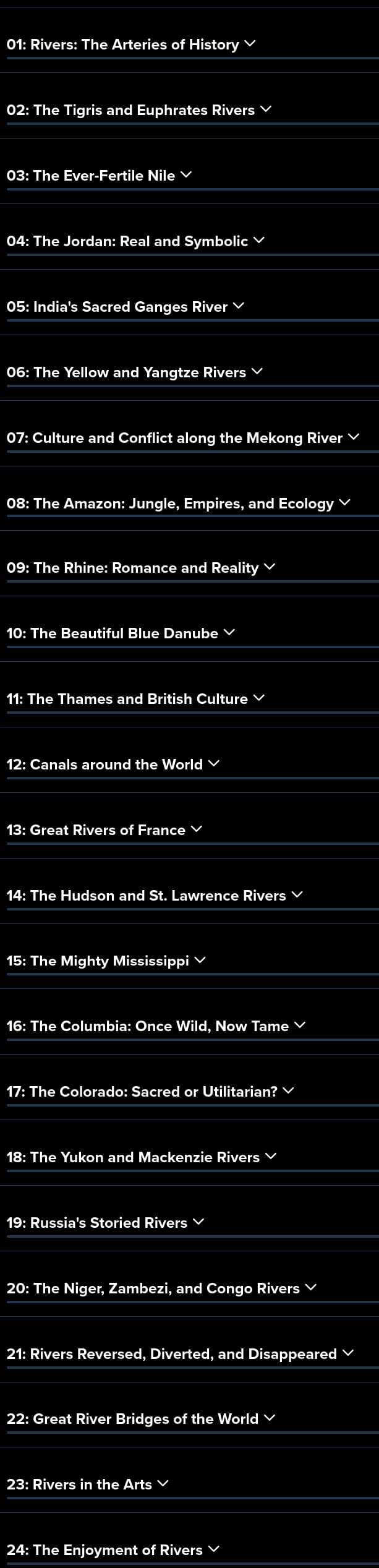
Great Rivers That Shaped History, Throughout history, the world’s great rivers have been at the heart of human civilization. As sources of food and vital routes for transportation, trade, irrigation, travel, and religious rituals, rivers have shaped not only the landscapes through which they flow but also the societies and cultures that developed along their banks. In Great Rivers That Shaped History, Professor Patrick N. Allitt of Emory University takes you on a global journey through 24 lectures exploring the geographical features, historical events, cultural traditions, economic activities, and environmental challenges associated with some of the world’s most influential waterways. Travel through the Middle East to explore the Tigris, Euphrates, Nile, and Jordan; discover the religious and cultural significance of India’s Ganges; and examine the Yellow, Yangtze, and Mekong rivers in Asia. Explore Europe’s Rhine, Danube, Thames, Seine, Loire, and Volga, as well as North America’s Mississippi, Hudson, St. Lawrence, Columbia, Colorado, Yukon, and Mackenzie rivers. Journey through the Amazon basin and investigate the importance of Africa’s Niger, Zambezi, and Congo rivers. Along the way, discover how waterways supported ancient civilizations, facilitated migration and commerce, influenced warfare and empire building, and helped shape national identities. The course also examines the geological formation of rivers, their deltas and waterfalls, and the ways people have altered them through dams, levees, canals, and other engineering projects. These interventions have brought benefits such as irrigation, flood control, transportation, and electricity, but they have also created environmental and social challenges.
What you’ll learn
- Understand the geological formation of rivers and recognize their major geographical features, including deltas and waterfalls.
- Explain how rivers have supported the growth of civilizations through food production, transportation, trade, and irrigation.
- Explore the historical, cultural, religious, and political significance of the Tigris, Euphrates, Nile, and Jordan rivers.
- Understand the religious importance of the Ganges and its role in Indian culture, communities, and environmental challenges.
- Examine how China’s Yellow and Yangtze rivers have influenced national development, conflict, and infrastructure.
- Analyze the Mekong River’s role in Southeast Asian civilizations, colonial history, modern conflicts, and environmental change.
- Explore the Amazon River system, its biodiversity, its ecological importance, and the history of European exploration and the rubber industry.
- Explain how European rivers, including the Rhine, Danube, Thames, Seine, Loire, Rhône, and Volga, have shaped trade, politics, culture, and national identity.
- Understand the roles of North American rivers in exploration, migration, trade, warfare, and economic development.
- Examine the significance of Africa’s Niger, Zambezi, and Congo rivers in exploration, trade, colonialism, and cultural history.
- Evaluate the benefits and consequences of human interventions in rivers, including dams, reservoirs, levees, aqueducts, and river diversions.
- Trace the development of canals and understand their roles in irrigation, transportation, water management, and global trade.
- Discover how river bridges reflect developments in engineering, construction techniques, and architectural design.
- Explore how rivers have inspired music, poetry, painting, literature, and other forms of artistic expression.
- Understand the historical and contemporary recreational value of rivers and their continuing importance to human life.
Who this course is for
- Anyone interested in world history and the development of human civilizations.
- Learners who want to understand the geographical and geological features of major rivers.
- People interested in the cultural, religious, and political histories of different regions of the world.
- Students and enthusiasts of geography, environmental history, and human interaction with nature.
- Anyone interested in the influence of rivers on trade, transportation, technology, and economic development.
- People who enjoy exploring the connections between rivers, art, literature, music, and architecture.
- Lifelong learners who want to explore the world’s major waterways through historical narratives, maps, and visual materials.
Specificatoin of Great Rivers That Shaped History
- Publisher : The Great Courses
- Teacher : Patrick N. Allitt
- Language : English
- Level : All Levels
- Number of Course : 24
- Duration : 12 hours and 31 minutes
Content of Great Rivers That Shaped History
Pictures

Sample Clip
Installation Guide
Extract the files and watch with your favorite player
Subtitle : Not Available
Quality: 720p
Download Links
Password file(s): www.downloadly.ir
File size
10.65 GB