


Description
Simulation Modeling for Data Science with Python and AI is a course on how to use simulation techniques, Python programming, and AI to model and analyze complex systems, published by Udemy Online Academy. Designed for data scientists, Python developers, engineers, researchers, and aspiring AI professionals, this course explores how simulation can be used to understand system behavior, test scenarios, estimate outcomes, and support data-driven decision making. Learners will work with probability, random variables, statistical distributions, Monte Carlo simulation, discrete event modeling, data analysis, and simulation workflows with the help of AI.
In this valuable course, instead of learning patterns from the past, we model how the system itself works and then run thousands of possible scenarios to understand a wide range of possible outcomes. Simulation modeling complements the analytics, machine learning, and simulation you already know, allowing you to answer questions about new situations. If you can read Python and have ever provided analytics, you have the prerequisites. You won’t be writing code from scratch, but you will choose modeling parameters, validate the generated code using structured techniques, and communicate the results in a way that managers and executives can act on.
What you will learn in Simulation Modeling for Data Science with Python and AI:
- Use a spec-first AI workflow: write a structured model spec, generate working Python with Claude or ChatGPT, and iterate without coding from scratch
- Answer real business questions under uncertainty, from capital reserves to staffing plans to product launches, with models you build yourself
- Validate AI-generated code in three layers (read, assert, stress-test) so you can defend your results to a skeptical stakeholder
- Run the what-if scenarios analytics and ML can’t: simulate futures with no historical precedent and report them with confidence intervals
- Build a Monte Carlo loan portfolio risk model with correlated defaults, policy levers, and recession stress scenarios
- Build a discrete-event clinic patient-flow model with realistic arrivals, peak-aware staffing, and an ops manager dashboard
- Choose the right paradigm for a new problem (Monte Carlo, discrete-event, system dynamics, agent-based) and the right distribution for each uncertain input
- Communicate simulation results in a one-page deliverable that earns the model the right to be acted on
- and …
Course specifications
Publisher: Udemy
Instructors: Dan Sullivan
Language: English
Level: Introductory to Advanced
Number of Lessons: 59
Duration: 4 hours and 57 minutes
Course topics
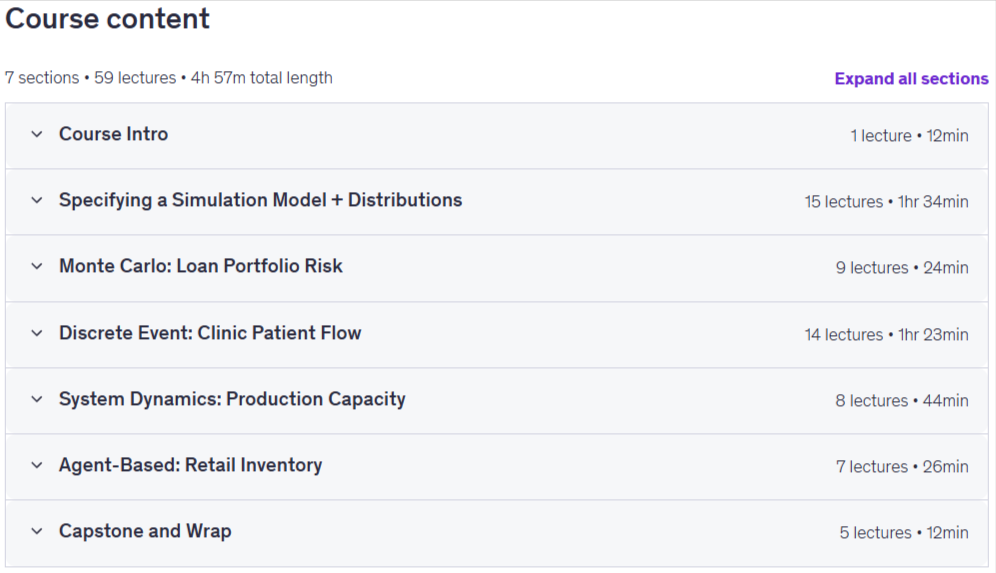
Simulation Modeling for Data Science with Python and AI Prerequisites
No programming or statistics background required. You’ll read and verify code rather than write it, and every math concept is taught picture-first, with no calculus needed.
A free account with an AI chat assistant such as Claude or ChatGPT, for generating code from your specs.
A web browser. Labs run in Udemy’s built-in Jupyter environment, so there’s nothing to install; the final section covers optional local setup.
Pictures
Simulation Modeling for Data Science with Python and AI introduction video
Installation guide
After Extract, watch with your favorite Player.
Subtitle: None
Quality: 1080p
Downloadly link
Rapidgator link
File password (s): www.downloadly.ir
Size
1.8 GB