

Description
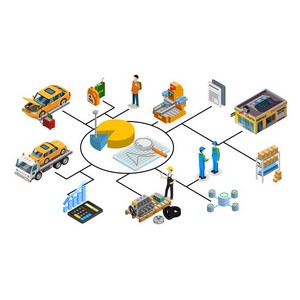
Introduction to Reliability, Maintainability & Availability course. This course focuses on actions that project managers and systems engineers can take to initiate or improve the performance of their systems. This course covers both “Design for RM&A” and “Validation for RM&A” activities to provide system developer and end user perspectives. This course also covers the necessary mathematical calculations necessary to initiate, specify, and test RM&A requirements, and includes an application of how to use RM&A calculations to estimate and improve the overall availability of your system.
What you will learn in this course
- What is a failure and why is it important to document its definition?
- How complexity in a system reduces its reliability
- What are the different distributions of failure data and how do they apply to system reliability
- Failure probability density (PCF) and failure cumulative distribution function (CDF) curves
- Mean, median and mode of failure data distributions
- The difference between failure rate λ(t) and hazard rate h(t)
- The concept of Van curve and its limitations
- Reliability networks, their types and applications
- FMEA and FMECA, their relationships and their application in system design concepts
- Difference between maintainability and maintainability
- Why mission scenario is an operational concept important to RM&A
- Different levels of maintenance and types of maintenance
- Criteria used to measure maintainability
- What is Reliability Based Maintenance (RCM) and its relationship with Condition Based Maintenance (CBM)
- Finding the optimal balance between reliability, maintainability and product life cycle cost
- Concept of potential to failure (PF)
- Types of availability: operational availability (Ao), inherent availability (Ai) and achieved availability (Aa), and how to calculate each
- The relationship between availability, reliability and maintainability
This course is suitable for people who:
- Managers and senior managers of product development
- Project managers
- System engineers
- Development team members
- Design engineers
- Hardware engineers
- Process engineers
- Maintenance specialists
- Logistics specialists
- Newcomers to the field of reliability
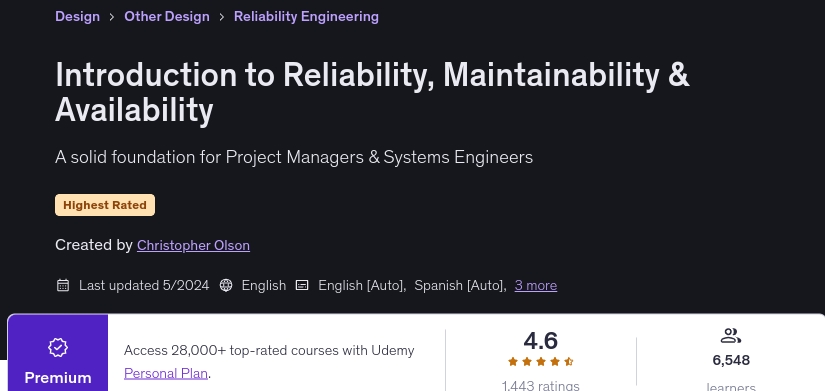
Introduction to Reliability, Maintainability & Availability course specifications
- Publisher : Udemy
- Teacher : Christopher Olson
- Language: English
- Level : All Levels
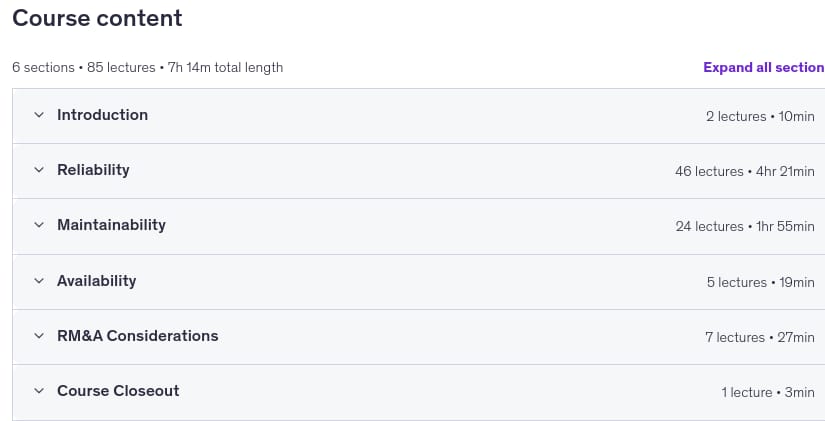
- Lectures : 85
- Duration : 7 hours and 14 minutes
Headlines of the course
Prerequisites of the Introduction to Reliability Maintainability & Availability course
- Product Development & Systems Engineering Foundations
- Algebra I & II
- Applied Statistics (helpful but not required)
- Trigonometry / Pre-Calculus (helpful but not required)
- Calculus I (Limits & Derivatives) (helpful but not required)
- Calculus II (Integration, sequences & series) (helpful but not required)
Course images
Sample video of the course
Installation guide
After Extract, view with your favorite Player.
Subtitle: English
Quality: 720p
The 2024/5 version has increased the number of lessons by 12 and the duration increased by 8 minutes compared to 2022/8.
download link
File(s) password: www.downloadly.ir
File size
2.72 GB
2 Comments. Leave new
Hello,
Please add rapidgator links as is possible.
Thanks in advance.
Hi
You can download from VIP servers only:
https://downloadlynet.ir/downloads/vip-membership